
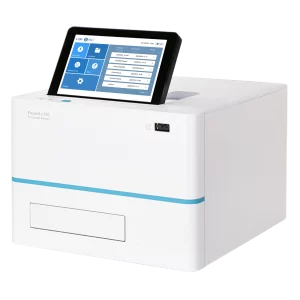
Microplate Reader
Find the Right Microplate Reader for Your Lab
Choosing the perfect microplate reader starts here. Use these key points to quickly compare our models and find the best fit for your application, throughput, and budget.
- By Detection Mode: Select from dedicated Absorbance readers for ELISA and colorimetric assays, or versatile multi-mode systems that include Fluorescence and Luminescence for more sensitive research.
- By Application: We offer solutions optimized for DNA/protein quantification, cell-based assays, enzyme kinetics, and more.
- By Throughput: Find models compatible with standard 96-well plates for everyday tasks or advanced readers for 384- to 1536-well high-throughput screening.
New to Microplate Readers?
Before you choose, it’s important to understand the core technology. Our comprehensive guide explains everything from basic principles to key applications, ensuring you make an informed decision.
Read Our Expert Guide: What Is a Microplate Reader?



Q&A:
1. Q: Why choose a HINOTEK Microplate Reader?
Choosing HINOTEK means investing in proven reliability, performance, and value. With nearly 20 years of manufacturing expertise, we offer an extensive portfolio of Microplate Reader, all rigorously quality-controlled and backed by dedicated global support. Our efficient production provides you with premium technology at a competitive price.
2. Q:Which light source should I choose for the Microplate Reader?
A: The type of light source determines the reader’s wavelength range and suitability for different applications.
Halogen Lamps: Found in basic absorbance readers, halogen lamps are less expensive but have a more limited spectral range, typically only in the visible spectrum (above 340 nm). This makes them unsuitable for applications like nucleic acid quantification, which requires UV light.
Xenon Flash Lamps: These are the most common light source in modern multi-mode readers. They produce a high-intensity, broad-spectrum light, covering a wide range from ultraviolet (UV) to near-infrared (approx. 200–1000 nm). This makes them versatile for a vast array of assays.
Light-Emitting Diodes (LEDs): LEDs are cost-effective, stable, and long-lasting light sources. They emit light in a narrow band of wavelengths, which can be advantageous for specific assays by providing targeted excitation energy.
3. Q: What kind of quality and support can I expect?
A: You can purchase with complete confidence. Every instrument undergoes strict quality control before shipping. We provide expert remote installation and training support to get your team running quickly. All our products are backed by a full warranty and complimentary lifetime technical guidance to ensure your long-term success.
Need more details on process or logistics? For full information on purchasing, payment, and global shipping, please visit our complete Purchasing & Support Guide.