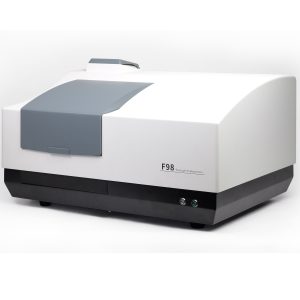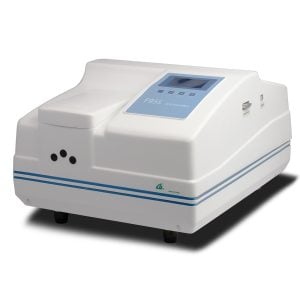
- Fluorescence Excitation: A specific wavelength from an excitation light source is used to excite the fluorescent markers in the sample to be tested. The excitation source is typically ultraviolet or blue light, which causes the fluorescent markers to enter an excited state.
- Fluorescence Detection: After being excited, the fluorescent markers in the sample emit a fluorescence signal at a specific wavelength. A fluorescence detector measures this emitted signal and converts it into an electrical signal.
- Signal Processing: The detected fluorescence signal undergoes amplification, filtering, and digital processing. The final processed signal is then displayed on the instrument’s screen or output to a computer for further analysis and processing.
The verification procedures for the F95S Fluorescence Spectrophotometer generally include the following aspects:
- Cleaning and Calibration: Regularly clean the instrument’s surface and optical components to ensure it operates in optimal condition. Calibrate the instrument’s sensitivity and accuracy to guarantee the reliability of measurement results.
- Spectral Calibration: Calibrate the instrument’s wavelength range and precision to ensure the accuracy of the measurement results.
- Fluorescence Signal Calibration: Use a fluorescent standard substance of a known concentration to perform fluorescence signal calibration, ensuring the instrument accurately measures the fluorescence signal of the test samples.
- Sensitivity Detection: Test the instrument’s sensitivity and linear range to verify that it can accurately detect fluorescent markers at different concentrations.
- Data Processing Validation: Verify that the instrument’s data processing algorithms are correct to ensure that the output data is accurate.
Spec:
|
Technical parameter |
technical indicators |
|
Model |
F95S |
|
Detection sensitivity |
Water Raman peak signal-to-noise ratio:S/N ≥90(P-P) |
|
Excitation wavelength bandwidth |
10nm |
|
Emission wavelength bandwidth |
10nm |
|
Emission wavelength accuracy |
±1.0nm |
|
Emission wavelength repeatability |
≤0.5nm |
|
Light source |
High-intensity LED cold light source |
|
Optical system |
C-T Monochromator Grating Automatic Wavelength Scanning |
|
Receiver |
Photomultiplier tube |
|
Excitation wavelength selectable range (LED light source) |
250~600nm |
|
Emission wavelength range |
(200-650)nm, expandable to 200-900nm |
|
Wavelength scanning speed |
Fastest 30000nm/min, fine scan 15nm/min |
|
measure linearity |
Correlation coefficient≥0.995 |
|
Gain adjustment range |
1~17 steps |
|
Integral response time |
6 steps optional: 0.1s~4s |
|
Data transmission method |
USB2.0 interface |
|
Power supply |
220V/50Hz,110V/60Hz |