
 |
What is a Nitrogen Evaporator?
An Nitrogen Evaporator is a specialized laboratory instrument. It is also known as a nitrogen blowdown evaporator . This system removes volatile solvents from liquid samples. It achieves this by directing a continuous stream of dry nitrogen gas over the sample surface . The gas stream sweeps away the vapor layer above the liquid . This action prevents the solvent from condensing back into the sample. This instrument helps laboratories prepare samples for downstream analysis . These analyses include high-performance liquid chromatography. They also include gas chromatography and mass spectrometry .
This page is a comprehensive technical guide to these systems. It covers their scientific principles, mechanical components, applications, and operating protocols. It also explains how to select the right system for your laboratory.
This is how it works. The instrument combines gas flow and controlled heating. The heating source warm-up occurs from below. Simultaneously, adjustable needles blow nitrogen gas onto the liquid surface . This combination accelerates solvent evaporation without causing sample splashing .
2. Scientific Principles of Solvent Evaporation
Evaporation is a phase transition process. Liquid molecules absorb energy to transition into a gaseous state. This transition occurs exclusively at the liquid-gas interface. In a closed or static system, the air directly above the liquid becomes saturated. This saturation builds vapor pressure. The vapor pressure reaches thermodynamic equilibrium with the liquid phase. This equilibrium halts the net evaporation process .
The Thermodynamic Relationship
The relationship between temperature and vapor pressure is expressed by the Clausius-Clapeyron equation:
In this equation, [latex]P_1[/latex] and [latex]P_2[/latex] represent the solvent vapor pressures at absolute temperatures [latex]T_1[/latex] and [latex]T_2[/latex] . [latex]\Delta H_{\text{vap}}[/latex] represents the enthalpy of vaporization. [latex]R[/latex] represents the universal gas constant . [latex]T[/latex] represents the absolute temperature in Kelvin . This formula shows that vapor pressure increases as temperature rises. Higher vapor pressure leads to faster solvent evaporation.
The Evaporative Cooling Effect
Evaporation is an endothermic process . High-energy liquid molecules escape into the gas phase . This escape depletes the kinetic energy of the remaining liquid . Consequently, the liquid temperature drops . This phenomenon is called evaporative cooling. A lower temperature decreases the solvent vapor pressure. This decrease slows down the evaporation rate . An N2 sample concentrator uses a heat source to counteract this cooling effect . This heat source maintains the sample at a constant temperature .
Dalton’s Law of Partial Pressures
Dalton’s Law states that the total pressure of a gas mixture equals the sum of the partial pressures of its component gases . The formula is written as :
In a sample vial, the gas layer contains both air and solvent vapor . The partial pressure of the solvent vapor limits further vaporization . An N2 sample concentrator continuously introduces pure nitrogen gas . This gas flow sweeps the solvent vapor away from the liquid surface . This process reduces the partial pressure of the solvent vapor to near zero . It maintains a steep concentration gradient between the liquid and gas phases .
Fick’s Law of Diffusion
The rate of solvent mass transfer is governed by Fick’s Law . The simplified equation is :
In this equation, [latex]J[/latex] represents the diffusion flux . [latex]D[/latex] represents the diffusion coefficient of the solvent vapor . [latex]\frac{dC}{dx}[/latex] represents the concentration gradient across the boundary layer . The nitrogen gas stream minimizes the boundary layer thickness [latex]dx[/latex]. A thinner boundary layer increases the diffusion flux [latex]J[/latex]. This explains why gas flow accelerates solvent removal .
3. Key Components of an N2 Sample Concentrator
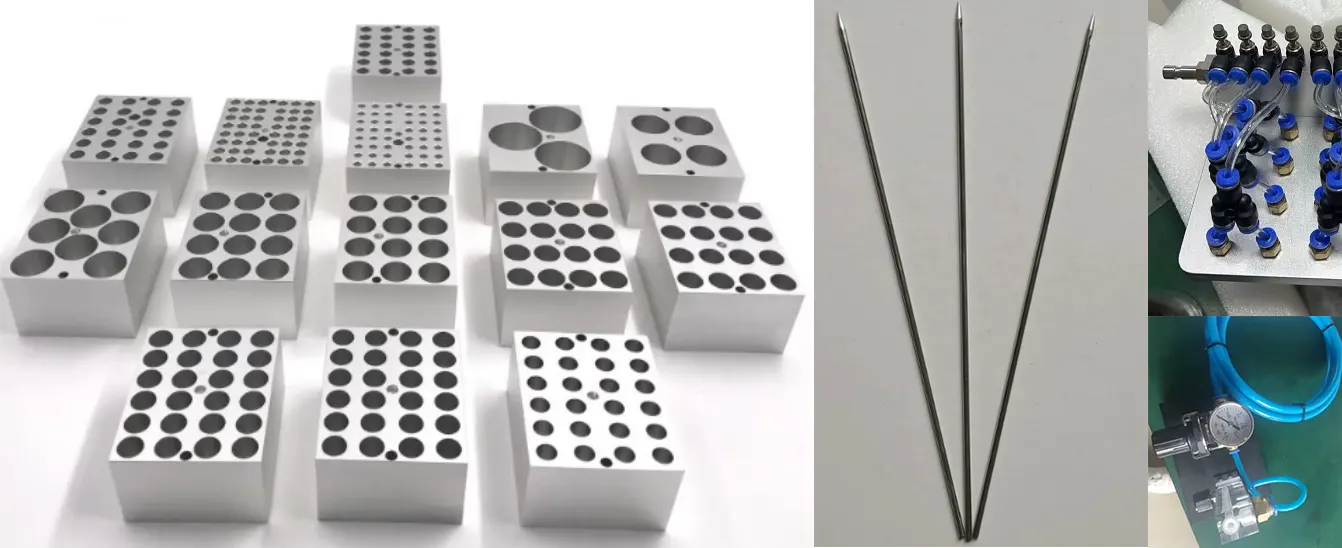
An N2 sample concentrator consists of several mechanical and pneumatic parts . These parts control the gas flow and the sample temperature .
 |
| Component Name | Primary Function | Construction Material |
|---|---|---|
| Gas Inlet Connection | Connects the instrument to the external nitrogen gas supply . | Brass or Stainless Steel . |
| Pressure Regulator | Reduces the high inlet pressure to a safe operating level . | Nickel-plated Brass or Stainless Steel . |
| Flow Meter | Measures the volumetric flow rate of the nitrogen gas . | Acrylic with Stainless Steel Float . |
| Gas Distribution Manifold | Splits the single nitrogen input into multiple parallel channels . | Anodized Aluminum or Stainless Steel . |
| Needle Valves | Allow independent adjustment of gas flow for each sample port . | Stainless Steel or Teflon . |
| Delivery Needles | Direct the gas stream onto the liquid surface of each sample . | 19-Gauge Stainless Steel . |
| Heating Block / Bath | Supplies thermal energy to counteract evaporative cooling . | Aluminum Block or Water Bath . |
| Vertical Stand and Lift | Adjusts the height of the manifold as the liquid level drops . | Stainless Steel with Spring Hoist . |
These components must resist corrosion from organic solvents . Stainless steel and anodized aluminum prevent chemical degradation .
4. Water Bath vs. Dry Block Heating Systems
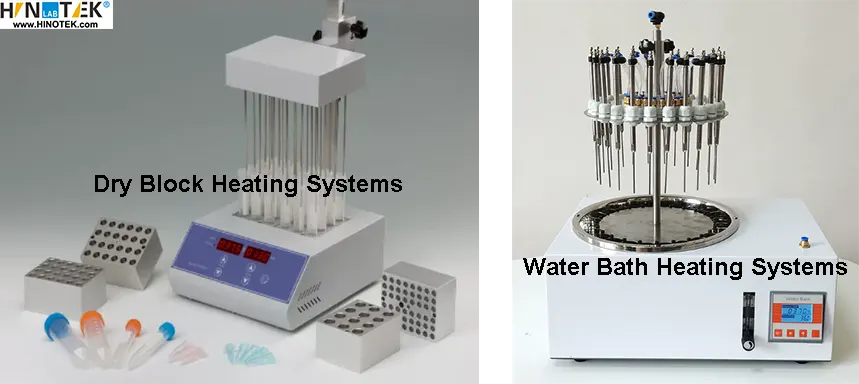
N2 sample concentrators use two primary heating methods . These are water bath heating and dry block metal heating . Each method transfers thermal energy differently .
Convective vs. Conductive Heat Transfer
Water baths transfer heat through liquid convection . The heated water surrounds the sample tubes . This coverage ensures uniform heat distribution across the submerged vial surface . It eliminates localized hot spots . This uniform heating is helpful when processing large batches of heat-sensitive samples .
Dry block heaters transfer heat through solid conduction . The sample tubes sit directly in machined aluminum wells . Heat travels from the heating element through the aluminum into the glass vial . This method heats up the block faster than a water bath . However, it requires a precise mechanical fit between the tube and the well . Any air gap will slow down the heat transfer rate .
Contamination Risk and Hygiene
Water baths present a higher risk of biological contamination . Standing water can harbor bacteria, algae, and fungi . This water can splash or condense onto the sample tube rims . Water condensation can ruin water-sensitive extraction steps .
Dry block heaters do not use a liquid medium . This design eliminates water-borne contamination pathways . The aluminum blocks can also be removed and autoclaved to maintain a sterile environment . This makes dry block systems suitable for molecular biology and DNA assays .
 |
| Feature Compared | Water Bath Heating Systems | Dry Block Heating Systems |
|---|---|---|
| Heat Transfer Efficiency | High, via liquid convection . | High, via solid conduction . |
| Temperature Uniformity | Excellent; no thermal gradients . | Moderate; dependent on vial fit . |
| Warm-Up Time | Slower (often 1 to 2 hours) . | Fast (typically 15 to 30 minutes) . |
| Maximum Temperature | Limited to 100°C . | Can exceed 150°C . |
| Contamination Risk | Higher; water can harbor microbes . | Extremely low; no liquid used . |
| Vessel Versatility | High; accommodates irregular vials . | Low; requires specific wells . |
| Maintenance Required | Weekly draining and scale cleaning . | Dry wipe-downs only . |
5. Selecting the Right Nitrogen Gas Source
An N2 sample concentrator requires a continuous supply of nitrogen gas . This supply can come from high-pressure gas cylinders or in-house gas generators .
Compressed Gas Cylinders
Gas cylinders contain high-purity nitrogen compressed to high pressures . This option requires a low initial investment . However, cylinders run out of gas and must be replaced frequently . Moving heavy, high-pressure cylinders also creates safety hazards in the laboratory . This option is suitable for low-throughput laboratories.
In-House Nitrogen Generators
Nitrogen generators produce a continuous flow of gas from ambient air . They eliminate the need for manual cylinder replacement . These systems utilize two primary separation technologies . These are Pressure Swing Adsorption (PSA) and Membrane Separation .
PSA generators use a carbon molecular sieve column . This column adsorbs oxygen under pressure while letting nitrogen pass through . This technology achieves high nitrogen purities, often exceeding 99.999% . It is ideal for sensitive analytical methods like GC-MS .
Membrane generators use hollow fiber membranes . These fibers allow oxygen and water vapor to permeate faster than nitrogen . This process generates a steady stream of nitrogen with purities up to 99.5% . This technology is suitable for high-flow applications like LC-MS sample preparation .
| Selection Metric | High-Pressure Gas Cylinders | In-House Gas Generators |
|---|---|---|
| Initial Equipment Cost | Low; requires only a regulator . | High; requires purchasing a generator . |
| Ongoing Operational Cost | High; continuous tank rental and refill fees . | Low; requires only electrical power . |
| Gas Supply Continuity | Interrupted; requires manual cylinder changes . | Continuous; generates gas on demand . |
| Safety Hazard Profile | High; risk of cylinder rupture . | Low; operates at lower pressures . |
| Purity Level Achieved | Up to 99.9999% . | Up to 99.999% (PSA technology) . |
6. Major Industrial Applications and Regulatory Methods
The N2 sample concentrator is used in many industries to meet regulatory standards . These methods require concentrating large volumes of solvent extract prior to analytical injection .
Environmental Testing
Environmental laboratories use nitrogen blowdown to isolate pollutants from water, soil, and air samples . For example, EPA Method 625 regulates the extraction of semi-volatile organic compounds (SVOCs) from wastewater . After extracting the sample with dichloromethane, technicians use nitrogen blowdown to concentrate the extract down to exactly 1.0 mL . This volume reduction increases the concentration of trace pollutants like phenols and phthalates, bringing them into the detection range of GC-MS instruments .
Similarly, EPA Method 610 outlines the detection of polynuclear aromatic hydrocarbons (PAHs) in municipal and industrial wastewater . The extraction solvent is typically dichloromethane or hexane . Nitrogen blowdown concentrates the extraction solvent gently . This step protects volatile PAHs like naphthalene from evaporating along with the solvent .
The Crucial Case of PFAS Analysis
Per- and polyfluoroalkyl substances (PFAS) are persistent organic pollutants . They are widely regulated in drinking water under EPA Methods 537.1 and 533 . PFAS compounds are highly sensitive to laboratory contamination . Many standard laboratory instruments contain polytetrafluoroethylene (PTFE, commonly known as Teflon) components . These components can leach trace PFAS into the sample during preparation, leading to false-positive results .
To prevent this, laboratories must use **Teflon-free N2 sample concentrators** . These specialized instruments replace all fluoropolymer tubing, connectors, and manifold seals with stainless steel or phthalate-free alternatives . This ensures that the concentration step does not introduce background contamination .
Clinical Screening and Forensic Toxicology
Forensic laboratories use nitrogen blowdown to concentrate drug extracts from biological fluids like blood, urine, and saliva . These extractions isolate therapeutic drugs, narcotics, and toxins . The target analytes are often present in trace amounts . For example, screening for cannabinoids, steroids, or synthetic opioids requires concentrating sample extracts down to dryness . The dry residue is then reconstituted in a mobile phase optimized for LC-MS/MS injection .
7. Practical Operating Manual (SOP)
This is how you operate a dry block N2 sample concentrator correctly . Following these steps prevents sample loss and contamination .
Phase 1: Installation and Warm-Up
First, place the instrument inside a functional laboratory fume hood . Connect the main gas inlet to your regulated nitrogen supply . Ensure the inlet pressure is set between 5 and 10 psig . Select the dry block that matches your sample vial diameter . Slide the block into the heating well . Turn on the power and program the temperature controller . Wait 15 to 30 minutes for the block temperature to stabilize .
Phase 2: Needle Alignment
Place your sample vials into the heated block . Grab the spring hoist assembly handle and lower the gas manifold . Position the delivery needles directly over the center of each sample . Adjust the needle height so that the tips sit 10 to 15 mm above the liquid meniscus . Do not let the needles touch the liquid . This height prevents sample cross-contamination and gas blocking .
Phase 3: Gas Flow Regulation
Open the primary gas valve on your regulator . For the channels containing samples, open the individual needle valves by turning them counter-clockwise . Adjust the flow meter until a gentle depression forms on the solvent surface . This surface depression is called a dimple . Do not allow the liquid to splash or bubble violently . If splashing occurs, turn the flow control valve clockwise to reduce the gas velocity .
Phase 4: Height Adjustments during Evaporation
As the solvent evaporates, the liquid level in the vials will drop . This increase in distance reduces the gas velocity at the liquid surface . To maintain a steady evaporation rate, use the hoist assembly to lower the manifold . Maintain the 10 to 15 mm gap between the needle tips and the solvent surface throughout the process . This helps you complete the concentration step faster .
Phase 5: Shut-Down and Clean-Up
Once the solvent reaches its target volume, close the individual needle valves . Raise the gas manifold to its top position . Remove the sample vials from the block . Turn off the main gas supply valve . Turn off the heater power switch . Allow the block to cool to room temperature before handling .
8. Solvent Compatibility and Operating Setpoints
The operating temperature of the heating block must be set relative to the boiling point of your solvent . Setting the temperature too high will cause the solvent to boil and bump, leading to analyte loss . Setting the temperature too low will slow down the evaporation process .
Operational Rule: Set the block temperature [latex]10^\circ\text{C}[/latex] to [latex]20^\circ\text{C}[/latex] below the boiling point of your solvent . This ensures rapid evaporation while keeping your analytes safe from thermal degradation .
| Solvent Name | Boiling Point | Recommended Block Temperature | Primary Application Area |
|---|---|---|---|
| Diethyl Ether | 34.6°C | 25°C to 30°C | Lipid extracts and fat-soluble vitamins . |
| Dichloromethane (DCM) | 39.6°C | 30°C to 35°C | Environmental pesticide residues and PAHs . |
| Methanol | 64.7°C | 35°C to 45°C | Clinical toxicology drug extractions . |
| Hexane | 69.0°C | 35°C to 50°C | Fat-soluble vitamins and non-polar compounds . |
| Ethyl Acetate | 77.1°C | 40°C to 55°C | Food safety contaminant screening . |
| Acetonitrile | 82.0°C | 40°C to 50°C | Pharmaceutical and peptide extracts . |
| Water (Aqueous) | 100.0°C | 70°C to 90°C | Biological and clinical fractions . |
Some volatile compounds can be evaporated at ambient laboratory temperatures using gas flow alone . This technique protects heat-sensitive biomarkers from thermal degradation .
9. HINOTEK N2 Sample Concentrator Product Line
HINOTEK designs and manufactures high-precision dry block N2 sample concentrators for different throughput requirements . These systems are reliable, easy to use, and consume minimal gas .
HN200 Sample Concentrator
The HN200 is designed for high-temperature applications . It features a wide temperature control range from room temperature plus [latex]5^\circ\text{C}[/latex] up to [latex]180^\circ\text{C}[/latex] . This high-temperature capability makes it suitable for evaporating high-boiling point solvents like water, DMSO, or DMF . The LED display shows the setting and actual values simultaneously . It includes an automatic fault detection system and a built-in over-temperature protection device to ensure laboratory safety .
MD200-1 and MD200-2 Sample Concentrators
The MD200 series is the standard for routine laboratory concentration . The MD200-1 accommodates a single block, while the MD200-2 holds two blocks simultaneously . These models operate from room temperature plus [latex]5^\circ\text{C}[/latex] to [latex]150^\circ\text{C}[/latex] . They use long 150 mm stainless steel needles to allow flexible height adjustments . A key technical feature of the MD200 series is its gas efficiency . It consumes only 330 mL/min of nitrogen per sample position . This low consumption rate reduces your nitrogen cylinder replacement frequency, lowering daily operational costs .
Mini-SC and Mini-SCN Portable Sample Concentrators
The Mini-SC and Mini-SCN are the smallest sample concentrators globally . They combine a compact heating block with an integrated micro-air pump . These portable systems do not require an external compressed gas cylinder . They run on a 12V DC input, making them suitable for mobile testing stations and field detection vehicles . They can process up to 6 samples simultaneously and operate at temperatures up to 80°C .
| Specification Parameter | HINOTEK HN200 | HINOTEK MD200-1 | HINOTEK MD200-2 | HINOTEK Mini-SC / SCN |
|---|---|---|---|---|
| Sample Capacity | 12 or 24 channels | Up to 24 channels | Up to 48 channels | 6 channels |
| Temperature Range | RT + 5°C to 180°C | RT + 5°C to 150°C | RT + 5°C to 150°C | RT + 5°C to 80°C |
| Temperature Accuracy | ±0.5°C (at ≤100°C) | ±0.5°C (at ≤100°C) | ±0.5°C (at ≤100°C) | ±0.5°C |
| Heating Time (to Max Temp) | ≤30 minutes | ≤30 minutes | ≤30 minutes | ≤12 minutes (to 80°C) |
| Nitrogen Consumption | 0 to 10 L/min | 330 mL/min per sample | 330 mL/min per sample | No cylinder needed |
| Power Supply Required | AC 220V, 50/60Hz | AC 220V, 50/60Hz | AC 220V, 50/60Hz | DC 12V |
| Net Weight | 7.0 kg | 5.5 kg | 6.5 kg | 3.0 kg |
10. Troubleshooting, Safety, and Maintenance Log
Proper maintenance of your N2 sample concentrator ensures reliable analytical results and long equipment life .
Troubleshooting Matrix
If you observe uneven evaporation rates across your sample block, first check the delivery needles for blockages . Dissolved residues or salts can accumulate on the needle tips, restricting gas flow . Clean the needles by flushing them with a clean, volatile solvent like acetone or methanol . Also, verify that all sample vials fit tightly inside the aluminum wells . An loose fit will create thermal variations, causing some samples to evaporate slower than others .
If your samples are splattering or bubbling out of the vials, your gas pressure is set too high . Turn the primary regulator valve clockwise to reduce the total flow rate, or lower the individual needle valves . Ensure that your delivery needles are positioned at least 10 mm above the liquid meniscus .
Maintenance Protocols
Wipe down the heating block surfaces weekly to remove any chemical spills or dust . If you are using a water-bath model, drain the water completely once a week . This prevents mineral scale buildup and microbial growth . Clean the water tank using a mild detergent or a dilute vinegar solution . For dry block systems, clean the aluminum well surfaces with a non-corrosive disinfectant . Inspect the gas inlet lines monthly for small cracks or signs of wear . Replacing worn tubing prevents nitrogen leaks and maintains gas pressure .
Nitrogen Safety Guidelines
Nitrogen is an asphyxiant gas . When high volumes of nitrogen escape into a closed room, the gas displaces oxygen from the air .