
Guide Navigation
- 1. Introduction: The Criticality of Moisture Quantification
- 2. The Physics and Chemistry of Moisture
- 3. Anatomy of a Laboratory Moisture Analyzer
- 4. Method Development: The Art of the Recipe
- 5. Industry-Specific Applications and Standards
- 6. Operational Excellence: Maintenance and Calibration
- 7. Economic Analysis: Return on Investment (ROI)
- 8. HINOTEK Solutions
- 9. Conclusion
 |
1. Introduction: The Criticality of Moisture Quantification
In the precise world of material science and industrial quality control, “moisture” is not merely the presence of water; it is a critical variable that dictates the mechanical integrity of polymers, the shelf-life of pharmaceuticals, the fair trade of agricultural commodities, and the sensory profile of food products. The term “Moisture Analyzer” is often used colloquially to describe a vast spectrum of instrumentation, ranging from simple handheld conductivity probes used by woodworkers to sophisticated Laboratory Moisture Analyzer (View HINOTEK Moisture Analyzer) used in regulated environments.
This comprehensive guide serves as a pillar resource for laboratory technicians, quality assurance managers, and process engineers. It dissects the technology behind moisture determination, specifically focusing on the Halogen Moisture Analyzer—the workhorse of the modern laboratory. By bridging the gap between theoretical thermodynamics and practical application, this report elucidates how instruments like the HINOTEK DHS series function, how they differ from secondary screening tools, and why accurate moisture control is a non-negotiable pillar of operational excellence.
1.1 Defining the Instrument: Meter vs. Analyzer
While the nomenclature is often interchanged, a technical distinction exists between a “meter” and an “analyzer” based on the measurement principle and the intended application depth.
| Feature | Handheld Moisture Analyzer | Laboratory Moisture Analyzer |
|---|---|---|
| Primary Technology | Secondary (Indirect): Electrical resistance (conductance) or capacitance (dielectric constant). | Primary (Direct): Thermogravimetric Analysis (Loss on Drying – LOD). |
| Measurement Principle | Correlates an electrical property to moisture content based on pre-calibrated charts. | Physically removes volatiles via heating and measures the precise weight loss. |
| Accuracy | Generally ± 0.5% to ±2.0%; heavily influenced by density and temperature. | High precision, typically ±0.01% to ±0.001% depending on sample size. |
| Typical Use Case | Field testing (grain elevators, lumber yards, building inspection). | Laboratory Quality Control (QC), R&D, production release. |
| Sample State | Non-destructive (often); measures whole grains or solid wood. | Destructive; sample is altered/consumed by the drying process. |
| Reference Standard | Calibrated against a standard (often an oven method). | Acts as an accelerated reference method itself (when validated). |
The Laboratory Moisture Analyzer, the primary focus of this report, integrates a precision weighing unit with a heating module to automate the standard oven-drying method. It provides a direct measurement of Loss on Drying (LOD), which encompasses all volatile substances—water, solvents, and low-boiling-point organics—that evaporate under the specific thermal conditions applied.
2. The Physics and Chemistry of Moisture
To master the operation of a Moisture Analyzer, one must first understand the behavior of water within different matrices. Water is not a passive occupant; it interacts dynamically with the host material.
2.1 Forms of Moisture in Materials
The energy required to remove moisture depends on how the water molecules are associated with the solid.
- Surface (Free) Moisture: This encompasses water adhering to the outer surface of particles or trapped in large interstitial spaces. It creates a high vapor pressure and evaporates readily. In a Moisture Analyzers, this is the first component to volatilize, typically during the initial heating ramp. Removal of free moisture is energetically equivalent to the evaporation of pure water.
- Capillary (Absorbed) Moisture: Water held within the porous structure of the material (e.g., inside a grain kernel or a tablet granule) is subject to capillary forces. The vapor pressure of capillary water is lower than that of free water (Kelvin equation). As drying proceeds, moisture must diffuse from the core to the surface to evaporate. This diffusion process is often the rate-limiting step in the “falling rate” period of the drying curve.
- Chemically Bound Moisture (Water of Crystallization): Some materials, such as gypsum (CaSO4.2H2O) or certain pharmaceutical hydrates, contain water molecules as an integral part of their crystal lattice. Removing this water requires specific, often higher, temperatures to break the chemical bonds.
- Analytical Implication: In LOD methods, the user must decide if bound water constitutes “moisture.” For example, if a pharmaceutical hydrate loses its crystal water, it effectively becomes a different chemical entity. The drying temperature must be chosen carefully to remove free moisture without stripping bound water if only surface moisture is the target.
2.2 Thermodynamics of the Drying Process
The operation of a Moisture Analyzer is a thermodynamic exercise. The instrument supplies thermal energy (Heat of Vaporization) to the sample. The drying process typically follows a characteristic curve with distinct phases:
2.2.1 Phase I: The Warm-Up Period
Upon starting the test, the sample temperature rises from ambient to the wet-bulb temperature. Little evaporation occurs here.
2.2.2 Phase II: The Constant Rate Period
As the sample reaches a critical temperature, free water on the surface begins to evaporate.
- Mechanism: The rate of evaporation is controlled by the rate of heat transfer to the surface and the removal of vapor from the surface.
- Equilibrium: The surface remains saturated with water. The temperature of the solid is relatively constant (approximately the wet-bulb temperature of the drying air) because the incoming thermal energy is largely consumed by the latent heat of evaporation. This phase removes the bulk of the moisture in high-water-content samples (e.g., wastewater sludge, milk).
2.2.3 Phase III: The Falling Rate Period
Once the surface drys out, the “critical moisture content” is reached. The drying front recedes into the interior of the solid.
- Mechanism: Moisture must diffuse through the solid matrix to reach the surface. This diffusion is slower than surface evaporation.
- Risk: The drying rate drops significantly. Crucially, because the evaporation rate slows, the cooling effect of evaporation diminishes. The sample temperature begins to rise toward the chamber temperature. This is the critical zone for scorching. If the analyzer’s heating profile is too aggressive during this phase, the sample temperature may exceed its decomposition point, causing burning (oxidation), which registers as false weight loss.
2.3 Loss on Drying (LOD) vs. Karl Fischer (KF) Titration
A frequent point of confusion in industry is comparing LOD results with Karl Fischer titration results. These methods measure different things.
- LOD (Thermogravimetric): Measures the total weight loss upon heating. This includes water, but also alcohol, aromatics, plasticizers, and other volatile organic compounds (VOCs). It is non-specific.
- Equation: %M = (Wwet – Wdry)/Wwet * 100
- Best For: Foods, plastics, agriculture, and materials where total volatile content is the quality parameter.
- Karl Fischer (Volumetric/Coulometric): A chemical reaction (Iodine + Sulfur Dioxide + Water) that is specific to water molecules. It does not measure other volatiles.
- Best For: Pharmaceuticals requiring water-specific assays, liquids with high VOCs, or trace moisture (<1%) where LOD lacks resolution.
- Reconciliation: If LOD results are consistently higher than KF results for the same sample, it indicates the presence of volatile impurities or sample decomposition.
3. Anatomy of a Laboratory Moisture Analyzer
The Laboratory Moisture Analyzer, exemplified by the HINOTEK DHS series, is a unified system combining a heating source, a weighing unit, and a microprocessor.
3.1 Heating Technologies: The Engine of Evaporation
The choice of heating element dictates the speed, precision, and repeatability of the analysis.
3.1.1 Halogen Radiators (The Modern Standard)
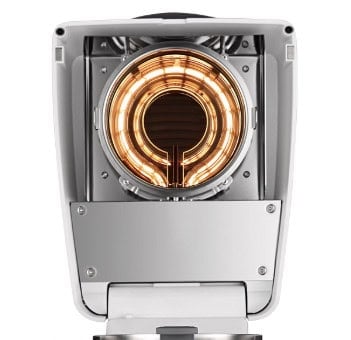 |
The Halogen Moisture Analyzer (e.g., HINOTEK DHS-16A) utilizes a tungsten filament encased in a quartz tube filled with halogen gas.
- Spectral Characteristics: Emits short-wave infrared radiation (0.75–1.5 µm). Short-wave radiation penetrates deeper into the sample than long-wave radiation, ensuring more uniform heating and preventing the formation of a hard “skin” (case hardening) that traps moisture.
- Thermal Response: The low thermal mass of the tungsten filament allows it to reach full power (e.g., 200°C) in seconds and cool down equally fast. This responsiveness enables advanced Drying Profiles (see Section 4.3) and precise temperature control, minimizing overshoot.
3.1.2 Infrared (Metal/Ceramic) Heaters
Standard IR analyzers use metal rods or ceramic elements.
- Spectral Characteristics: Emits medium-to-long wave infrared (2–10 µm). This energy is absorbed mostly at the surface.
- Thermal Inertia: These elements have high thermal mass. They take time to heat up and, crucially, continue to radiate heat after the power is cut. This “thermal lag” makes it difficult to execute rapid temperature changes or prevent scorching in sensitive samples.
3.1.3 Microwave Drying
Microwave systems heat the entire sample volume simultaneously by interacting with the dipoles of water molecules.
- Pros: Ultra-fast (seconds).
- Cons: Expensive; risk of “hot spots” causing splattering; unsuitable for thermally sensitive samples or very small sample masses.
3.2 Weighing Systems: The Sensor of Precision
The resolution of the moisture result is mathematically limited by the resolution of the balance.
3.2.1 Strain Gauge Load Cells
- Principle: A metal spring element deforms under load, changing the resistance of bonded strain gauges.
- Performance: Typically 0.01g (10mg) or 0.001g (1mg) readability.
- Application: Sufficient for high-moisture samples (e.g., soil, food) or large sample masses (10g+). HINOTEK’s DHS-16A utilizes precision load cells suitable for general lab use.
3.2.2 Electromagnetic Force Restoration (EMFR)
- Principle: A magnetic coil generates a force to counter the weight of the sample, maintaining a null position. The current required is measured.
- Performance: 0.0001g (0.1mg) or better.
- Application: Critical for low-moisture applications like plastics (moisture < 0.05%). If a 10g sample loses 0.01% moisture, the weight loss is only 1mg. A strain gauge with 1mg readability cannot reliably measure this; an EMFR cell is required to resolve the curve.
4. Method Development: The Art of the Recipe
A Moisture Analyzer is not a “magic box”; it follows the parameters set by the user. “Developing a Method” means defining the settings that yield a result matching the reference method (typically a drying oven).
4.1 Drying Temperature
The drying temperature is the most influential variable.
- Strategy: Ideally, set the temperature high enough to evaporate moisture quickly but low enough to prevent decomposition.
- Optimization:
- If the Analyzer result < Oven result: The temperature may be too low (incomplete drying) or the time too short.
- If the Analyzer result > Oven result: The temperature is likely too high, causing decomposition (scorching) or evaporation of non-aqueous volatiles.
4.2 Switch-off Criteria (Endpoint Determination)
The analyzer must know when to stop. Waiting for absolute zero weight change is impractical due to thermal drift and time constraints.
- Manual: Stop by operator (rare).
- Timed: Stop after a fixed duration (e.g., 10 mins). Good for routine checks of identical samples but ignores variations in initial moisture.
- Automatic (Rate-Controlled): The instrument stops when the rate of weight loss drops below a threshold (dM/dt).
- A30 (Fast): < 1mg loss in 30 seconds. Used for quick checks or high-moisture samples.
- A60 (Standard): < 1mg loss in 60 seconds. The industry default for most samples.
- A90 (Strict): < 1mg loss in 90 seconds. Essential for plastics and low-moisture samples where evaporation is very slow in the final phase.
4.3 Drying Profiles (Heating Modes)
The Halogen lamp’s responsiveness allows for tailored heating curves:
- Standard: Ramps to target and holds. (Default).
- Fast (Boost): Overshoots target (e.g., 140% of target) for the first few minutes to drive off surface water rapidly, then drops to setpoint. Ideal for liquids and slurries.
- Ramp: Linearly increases temperature over time. Used for samples that form a skin (e.g., syrups) or are highly flammable.
- Step: Dries at a low temperature (to remove free water), then steps up to a high temperature (to remove bound water). Useful for complex mixtures.
4.4 Sample Preparation
Proper preparation ensures the sample dries uniformly and quickly.
- Solids: Must be ground or crushed. A whole grain kernel traps moisture; ground flour releases it.
- Liquids/Pastes: Must be spread on a Glass Fiber Filter Pad. The pad increases surface area, prevents droplet formation (which reduces surface area), and prevents “skinning.” It also protects the sample pan from being soiled.
- Sample Mass: Typically 3–10g.
- Too small: Errors in weighing dominate.
- Too large: Drying takes too long; inner moisture may not migrate to surface before surface scorches.
5. Industry-Specific Applications and Standards
The versatility of the halogen Moisture Analyzer makes it indispensable across diverse sectors.
5.1 The Plastics Industry: Combating Hydrolysis
For polymer processors, moisture is a structural contaminant. Hygroscopic resins (Nylon, PC, PET) absorb moisture from the air.
- The Problem: During injection molding, high heat turns trapped moisture into superheated steam.
- Visual Defect: Splay Marks (Silver Streaks) appear on the surface of the part.
- Structural Defect: Hydrolysis occurs—water molecules cleave the polymer chains, reducing molecular weight and impact strength. A part may look perfect but fail under load.
- The Standard (ASTM D6980): This standard governs the use of Moisture Analyzers for plastics. It requires:
- Detection limit of 50 ppm (0.005%).
- Strict control of sample exposure to ambient air (loading must be fast).
- Use of A90 or similar strict switch-off criteria.
- Note: For very dry resins (<0.01%), high-end EMFR analyzers are required; standard strain gauge units may struggle to resolve the weight loss.
5.2 Pharmaceuticals: Precision and Compliance
- Tablet Manufacturing: Moisture content of granules dictates compressibility.
- Too Dry: Granules don’t bond; tablets suffer from Capping (top pops off) or Lamination (layers split).
- Too Wet: Granules stick to the punches (“Picking” or “Sticking”), causing machine downtime.
- Regulatory (USP <921>): While Karl Fischer is Method I, Loss on Drying (Method III) is permitted for many excipients and non-volatile drugs. The Moisture Analyzers offers a rapid, chemical-free alternative for in-process control.
5.3 Food and Agriculture: Safety and Economics
- Powder Flowability: Food powders (spices, milk powder, flour) are hygroscopic. As moisture rises, the Glass Transition Temperature (T_g) of the amorphous components drops. If T_g drops below ambient temperature, the powder becomes sticky, leading to caking and bridging in hoppers.
- Economic Impact: Water is weight. If a grain elevator buys corn at 15% moisture but sells it at 12%, they lose 3% of the inventory weight (shrinkage). Conversely, selling at 14.5% (just below the 15% limit) maximizes profit. Precision analyzers allow operators to blend grain to the exact moisture specification.
- Regulatory (AOAC): The AOAC provides official oven methods (e.g., 135°C for 2 hours for feed). Moisture Analyzers are validated against these methods for rapid QC.
5.4 Grain Moisture: The Handheld vs. Benchtop Debate
In agriculture, speed often competes with accuracy.
- Handheld Meters (Capacitance/Conductance):
- Technology: Measures the dielectric constant (k) or resistance. Water has a high k (~80) compared to starch (~4).
- Limitations: Readings are heavily influenced by Packing Density (air gaps lower the reading) and Temperature. Accuracy is typically \pm 0.5\%.
- Use: Field checks to decide if a crop is ready for harvest.
- Benchtop Analyzers (HINOTEK DHS / LOD):
- Technology: Loss on Drying (Thermogravimetric).
- Advantage: Independent of packing density, temperature, or grain shape. Provides the “absolute” moisture content.
- Use: Trade settlement, calibration of handheld meters, and precise storage monitoring.
6. Operational Excellence: Maintenance and Calibration
To maintain data integrity, the instrument requires a rigorous maintenance schedule.
6.1 Calibration: The Twin Pillars
A Moisture Analyzer is a balance and a heater; both must be calibrated.
- Weight Calibration:
- Frequency: Daily or prior to critical batch releases.
- Method: Use a certified calibration weight (e.g., 50g F1 class). This corrects for sensor drift and local gravity variations.
- Temperature Calibration:
- Frequency: Monthly or quarterly.
- Method: Requires a specialized Temperature Calibration Kit (a temperature sensor embedded in a disc that mimics a sample).
- Procedure: The analyzer runs a program heating to specific points (e.g., 100°C and 160°C). The probe reading is compared to the setpoint. If they deviate beyond tolerance ((e.g., ±2°C) , the instrument recalculates its PID parameters. This ensures that “105°C” on the screen truly means 105°C at the sample pan.
6.2 Cleaning and Care
- The Halogen Lamp: Must be kept clean. Fingerprints or dust create hotspots that shorten lamp life and alter the radiation profile. Clean only when cool using alcohol and a soft cloth.
- The Chamber: Debris from previous tests (e.g., burnt flour) can smoke or burn in subsequent tests, affecting results. The HINOTEK DHS series is designed with removable draft shields and pan handlers to facilitate easy cleaning.
7. Economic Analysis: Return on Investment (ROI)
Investing in a high-quality Moisture Analyzer is often justified by a single prevented failure.
7.1 Energy Savings
In industrial drying (e.g., drying corn or pharmaceutical granules), energy consumption is massive.
- Fact: Over-drying a product by just 1% can increase energy costs by 10% or more.
- Solution: Real-time Moisture Analyzers allows operators to stop the dryer exactly at the target moisture, saving fuel and increasing throughput.
7.2 Reducing Scrap
In plastics manufacturing, a single batch of parts rejected due to splay marks can cost thousands of dollars in material and machine time. A $2,000 Moisture Analyzer prevents this by verifying the resin before it enters the molder.
8. HINOTEK Solutions
HINOTEK provides a comprehensive range of moisture determination instrumentation tailored to these specific industrial needs.
- DHS Series (Halogen Moisture Analyzers): The flagship laboratory series. Models like the DHS-16A feature rapid halogen heating, precision weighing cells, and RS232 interfaces for data logging. They support temperature ranges up to 180°C, making them suitable for everything from food ingredients to engineering plastics.
- BKGM Series (Grain Moisture Analyzers): Designed for portability and field use, these meters utilize capacitance technology with automatic temperature compensation, providing farmers and elevator operators with immediate, actionable data.
9. Conclusion
The question “What is a Moisture Analyzer?” has two answers. In the field, it is a rapid screening tool for immediate decision-making. In the laboratory, it is a sophisticated Moisture Analyzers that serves as the final arbiter of quality. By leveraging the principles of thermogravimetry and halogen heating, modern analyzers like the HINOTEK DHS series provide the speed, accuracy, and reliability required by today’s rigorous manufacturing standards. Whether preventing the hydrolysis of a car bumper or ensuring the crunch of a breakfast cereal, the Moisture Analyzers is the silent guardian of product integrity.
f you are ready to find the right Moisture Analyzer for your laboratory, please browse our complete product range: Moisture Analyzer
This guide is maintained by HINOTEK’s core technical team, comprised of senior engineers and application scientists with over two decades of hands-on experience in fields such as Moisture Analyzer, centrifugation, and spectrophotometry. We are committed to ensuring that every piece of information in this guide—from instrument principles and technical specifications to laboratory procurement advice—maintains the highest level of accuracy and timeliness.
This content is regularly reviewed and updated to reflect the latest industry standards and technological advancements. We value feedback from the global scientific community. Should you have any questions or suggestions, or wish to discuss any technical details, please do not hesitate to contact our expert team at [email protected].
Workcite:
- Moisture Analyzers & Meters – GAO Tek
- How Does a Moisture Analyzer Work? – sisco.com
- Drying theory and drying rating curve | PPTX – Slideshare
- Understanding the Drying Rate in Dehydration Processes – Agriculture Institute
- Difference between Loss on Dry & karl fischer moisture test – Pharmaguideline Forum
- Karl Fischer versus Loss-On-Drying – News-Medical.net
- Rate of Drying: Constant Rate Period Falling Rate Period | PDF | Line (Geometry) – Scribd
- Five patterns of the drying curve – HEAT-TECH
- Karl Fischer vs. Loss-On Drying – Which Method is the Best?
- Moisture Analyzer Moisture Analyzer : To Karl Fischer, or not to Karl Fischer | Sterling Analytical Lab
- What are the types of moisture analyzers that exist? – Kalstein EU
- What is the difference between Halogen and Infrared Moisture Analyzer? – Camlab