
|
|

This article guide offers a detailed examination of the laminar flow cabinet (view HINOTEK Laminar Flow Cabinet Page) , intended for an audience of laboratory personnel, procurement managers, and global distributors who require a deep technical understanding of its principles, design, and application. We will explore the physics of controlled airflow, dissect the cabinet’s core components, compare different configurations, and provide clear guidance on its proper use and maintenance.
The Principle of a Controlled Atmosphere: Defining the Laminar Flow Cabinet
A laminar flow cabinet is a partially enclosed bench work surface meticulously designed to prevent the contamination of particle-sensitive materials within its operational area. Its primary purpose is to function as a primary barrier, establishing a consistently particle-free working environment for handling items such as biological samples, pharmaceutical preparations, medical devices, and sensitive electronic components. This is achieved by projecting a continuous, unidirectional stream of highly filtered air across the work surface, effectively sweeping away any potential airborne contaminants.
Within the industry, this equipment is known by several names, including “laminar flow hood,” “tissue culture hood,” and, particularly in manufacturing settings, “clean bench”. This variation in terminology often reflects the specific application, but the underlying technology remains the same. The term “clean bench” is particularly revealing, as it highlights the equipment’s central role in industries where the primary goal is ‘cleanliness’—the absolute absence of particles—as opposed to ‘containment,’ which involves preventing hazardous agents from escaping.
It is this singular focus on cleanliness that establishes the most critical characteristic of a laminar flow cabinet: its value proposition is exclusively unidirectional product protection. The entire engineering philosophy is inwardly focused on maintaining the sterility of the workspace. Consequently, the cabinet’s exhaust air, which has passed over the work surface and may now carry contaminants from the procedure, is typically directed outwards, towards the operator. This design feature means that a standard laminar flow cabinet offers no protection to the user or the surrounding environment and is fundamentally unsafe for work with pathogenic agents, toxins, or volatile chemicals. Any decision regarding its use must begin with a risk assessment of the materials being handled. If the material poses any risk to personnel, a different class of equipment is required.
The Physics of Clean Air: Laminar vs. Turbulent Flow
The effectiveness of a laminar flow cabinet is rooted in a fundamental principle of fluid dynamics: the difference between laminar and turbulent flow. The cabinet is not merely a box with a filter; it is an applied physics device engineered to generate and sustain a highly controlled and predictable airflow pattern.
|
|

Laminar Flow
Laminar flow, also known as streamline flow, is a condition where fluid particles move in smooth, parallel layers with minimal to no lateral mixing or disruption between adjacent layers. Imagine a deck of cards sliding over one another; each card represents a layer of air moving in a uniform direction and at a constant velocity. This state is characterized by a low Reynolds number, a dimensionless quantity used in fluid mechanics, where the fluid’s viscous forces (its tendency to resist deformation) are dominant over its inertial forces (its tendency to resist changes in motion). In a laminar flow cabinet, this predictable, unidirectional stream of air acts as a physical barrier or “air curtain,” systematically carrying potential contaminants away from the critical work area in a controlled manner.
Turbulent Flow
In stark contrast, turbulent flow is a chaotic, irregular flow regime characterized by the formation of swirls, vortices, and eddies. This condition occurs at high Reynolds numbers, where inertial forces overwhelm viscous forces. Instead of moving in parallel layers, the air tumbles and mixes unpredictably. If the air inside a clean cabinet were turbulent, filtered clean air would immediately mix with any contaminated air generated by the operator or the procedure, rendering the filtration system ineffective and leading to cross-contamination of the work surface.
The cabinet’s design, therefore, is optimized to maintain a constant state of laminar flow, typically achieving an air velocity between 0.3 and 0.5 m/s. This precise control of air as a physical medium is what transforms a simple stream of clean air into a robust protective shield for sensitive products. The performance of the cabinet depends not only on the quality of its filter but equally on its ability to maintain this delicate, predictable state of flow.
Anatomy of a Laminar Flow Cabinet: A Component-by-Component Analysis
A laminar flow cabinet is an integrated system of several critical components, each serving a specific function to create and maintain a sterile working environment. The quality of its construction and the interplay between these parts determine its overall performance and reliability.
Enclosure and Work Surface
The main body, or enclosure, provides the physical structure and isolates the work area from the surrounding environment. It is typically constructed from stainless steel, a material chosen for its exceptional durability, inherent resistance to corrosion and microbial growth, and ease of cleaning and disinfection. A crucial design feature is the absence of gaps, joints, or crevices where contaminants like bacterial or fungal spores could accumulate. This attention to material science and construction is a form of passive contamination control, as it denies microorganisms a place to colonize and potentially compromise the sterile field. A transparent front sash, usually made of safety glass or polycarbonate, allows for clear visualization of the work area while maintaining the air barrier.
The work surface is a flat, solid platform, also made of stainless steel, where all procedures are performed. In vertical flow models, this surface may be perforated to allow the air to exit the cabinet in a controlled manner.
Air Handling and Filtration System
The air handling system is the heart of the cabinet, comprising a multi-stage filtration process driven by a blower.
- Blower/Fan: This is the motor responsible for drawing ambient room air into the system and forcing it through the filters. The fan’s power, consistency, and low-vibration operation are essential for generating the constant, uniform pressure required to sustain a stable laminar airflow.
- Pre-Filter: Before reaching the main filter, room air first passes through a pre-filter, or filter pad. This is a less dense, often washable fibrous mat designed to capture larger airborne particles such as dust, lint, and pollen (typically those 5 microns or larger). The pre-filter serves a critical and cost-effective function: it protects the more delicate and expensive main filter from premature clogging, or “loading.” By acting as a sacrificial first line of defense, the pre-filter significantly extends the operational lifespan of the main filter and reduces the total cost of ownership.
- HEPA/ULPA Filter: After the pre-filter, the air is forced through the main filter, which is almost always a High-Efficiency Particulate Air (HEPA) filter or, for more stringent applications, an Ultra-Low Penetration Air (ULPA) filter. This component is responsible for removing microscopic contaminants and will be examined in detail in the following section.
Ancillary Components
- UV-C Germicidal Lamp: Many cabinets are equipped with an ultraviolet (UV-C) lamp for surface sterilization. The short-wavelength UV-C light is highly effective at destroying the DNA of bacteria, viruses, and other microorganisms, sterilizing the cabinet’s interior surfaces. It is critical to understand that the UV lamp should only be used to decontaminate the cabinet
when it is not in use, typically for a period of 15 to 30 minutes before work begins. The UV-C radiation is harmful to human skin and eyes, and the front sash must be closed and the lamp switched off before any work is performed. - Fluorescent/LED Lamp: A standard fluorescent or LED lamp is included to provide bright, even illumination of the work surface, ensuring precision and reducing operator fatigue during detailed procedures.
- Control Panel: An external control panel provides the user interface for operating the blower, interior lighting, and the UV lamp, and may include a pressure gauge to monitor the status of the HEPA filter.
The Science of Filtration: How HEPA and ULPA Filters Ensure Purity
The ability of a laminar flow cabinet to produce sterile air rests almost entirely on the performance of its main filter. Understanding how these filters work reveals a sophisticated interplay of physics that goes far beyond simple sieving.
The HEPA Filter Mechanism
A High-Efficiency Particulate Air (HEPA) filter is not a screen with tiny pores. It is a deep, pleated mat of randomly arranged borosilicate glass microfibers. The gaps between these fibers are often much larger than the particles the filter is designed to capture. Instead of physically blocking particles like a sieve, a HEPA filter traps them through a combination of three distinct physical mechanisms that act on particles of different sizes :
- Impaction: Larger, heavier particles (generally >1.0 micron) possess significant inertia. As the air stream curves to flow around a filter fiber, these particles cannot change direction quickly enough. They deviate from the air stream, collide directly with a fiber, and become trapped.
- Interception: Mid-sized particles (typically 0.4 to 1.0 micron) are light enough to follow the air stream as it flows around fibers. If a particle’s path brings it within one radius of a fiber, it will make contact and adhere to the fiber’s surface.
- Diffusion: The smallest, lightest particles (generally <0.1 micron) are so small that they are constantly bombarded by air molecules. This causes them to move in an erratic, random, zig-zag pattern known as Brownian motion. This chaotic movement dramatically slows their passage through the filter and greatly increases the probability that they will collide with and be captured by a fiber through impaction or interception.
The Most Penetrating Particle Size (MPPS)
Counterintuitively, there is a particle size that is the most difficult for a filter to capture. These particles are too small and light for impaction to be effective, yet too large and heavy for diffusion to be a dominant mechanism. This point of minimum efficiency is known as the Most Penetrating Particle Size (MPPS). For HEPA filters, the MPPS is generally accepted to be around 0.3 microns.
For this reason, filter performance is rated based on its efficiency at this “worst-case” particle size. The international standard for a HEPA filter is the ability to remove a minimum of 99.97% of airborne particles at 0.3 microns in size. A key point of understanding is that the filter’s efficiency is actually higher for particles both larger and smaller than the MPPS, as those particles are more effectively captured by impaction/interception and diffusion, respectively.
ULPA Filters: A Higher Standard
For applications demanding even greater air purity, such as in advanced semiconductor manufacturing or for achieving ISO Class 3 or 4 cleanroom standards, an Ultra-Low Penetration Air (ULPA) filter may be used. ULPA filters are constructed with a denser fiber mesh and are rated to remove a minimum of 99.999% of particles at their MPPS, which is typically smaller than that of HEPA filters, around 0.12 microns.
However, this superior filtration comes with significant trade-offs. ULPA filters are more expensive, have a shorter operational lifespan, and their denser media creates much higher resistance to airflow. This increased resistance requires a more powerful, energy-intensive blower and can reduce the overall air change rate in a room, potentially impacting the cleanliness of the surrounding environment. Therefore, the choice between HEPA and ULPA is not a simple matter of selecting the “better” filter but is a strategic decision based on a cost-benefit analysis of the application’s specific contamination risk versus the increased operational and maintenance costs. For the vast majority of laboratory and pharmaceutical applications, HEPA filtration provides more than sufficient protection.
Vertical vs. Horizontal: Selecting the Correct Airflow Configuration
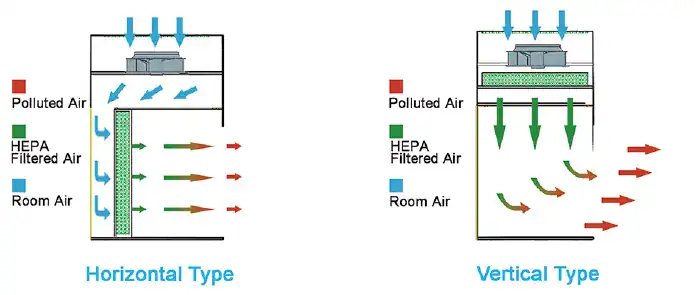
Laminar flow cabinets are available in two primary configurations, defined by the direction of the filtered airflow: horizontal and vertical. The selection between these two designs is not arbitrary; it is a critical decision based on the specific application, the equipment to be used within the cabinet, operator comfort, and the physical constraints of the laboratory.
 |
Horizontal Laminar Flow Cabinets
In a horizontal flow cabinet, the HEPA filter is positioned at the back of the enclosure. Room air is drawn in, filtered, and then projected forward in a horizontal direction, parallel to the work surface, exiting through the front opening towards the operator.
- Advantages: This configuration produces the least amount of air turbulence directly on the work surface, making it ideal for delicate procedures involving small components, such as electronics assembly, optics alignment, or non-hazardous drug compounding. A significant benefit is that the operator’s hands and gloves are downstream from the sample. This means any particles shed by the operator are immediately swept away from the work area, minimizing the risk of user-to-sample contamination.
- Disadvantages: The primary drawback is that the airflow is directed straight at the operator, offering no personnel protection from any aerosols or powders generated during the procedure. Furthermore, placing large or bulky equipment on the work surface can obstruct the airflow, creating downstream zones of turbulence and compromising the sterile field. There is also a risk of cross-contamination between items on the work surface, as particles from an item placed near the back (upstream) can be blown onto items placed closer to the front (downstream).
Vertical Laminar Flow Cabinets
In a vertical flow cabinet, the HEPA filter is mounted at the top of the enclosure. The filtered air is directed vertically downwards onto the work surface and then exits the cabinet through vents at the front and/or rear of the work area, or through a perforated work surface.
- Advantages: This design offers greater operator comfort and safety, as the air is not blown directly into the user’s face. It is far superior for working with large pieces of equipment (e.g., microscopes, spin coaters), as they do not significantly obstruct the primary path of the airflow from the top filter to the work surface. Vertical flow cabinets typically have a smaller footprint because the fan and filter assembly is on top, allowing them to be placed on a standard laboratory bench, which is a significant advantage in labs with limited floor space.
- Disadvantages: The downward flow can create slightly more turbulence as it impacts the work surface, which may disturb lightweight materials like powders or open containers of liquids. A critical consideration is that the operator’s hands and arms are upstream from the sample. This increases the risk of particles from gloves or sleeves falling directly onto the sterile work below, requiring meticulous aseptic technique.
Ultimately, the choice is a risk assessment of the dominant contamination source. If the primary risk is the operator contaminating the sample, a horizontal flow may be preferred. If the primary concerns are operator comfort, the use of large equipment, or cross-contamination between samples on the bench, a vertical flow is the superior choice.
| Feature | Horizontal Laminar Flow Cabinet | Vertical Laminar Flow Cabinet |
| Airflow Direction | From back to front, parallel to the work surface. | From top to bottom, perpendicular to the work surface. |
| Primary Advantage | Minimal turbulence on the work surface; low risk of user-to-sample contamination. | Accommodates large equipment; smaller footprint; greater operator comfort. |
| Primary Disadvantage | No operator protection; airflow is easily blocked by large items. | Potential for user-to-sample contamination from above; more surface turbulence. |
| Operator Protection | None. Air is exhausted directly at the user. | Minimal/Indirect. Air is not directed at the user, offering better comfort and safety. |
| Ideal Applications | Electronics assembly, optics, IV preparation, non-hazardous compounding, plant tissue culture. | Microbiology, cell culture work with non-hazardous agents, use of large equipment. |
| Footprint/Space | Requires a deeper workbench and rear clearance for air intake. | More space-efficient; can be placed on a standard lab bench. |
| Handling Large Items | Poor. Large items create significant airflow disruption and turbulence. | Excellent. Large items do not obstruct the primary airflow path from the filter. |
A Critical Distinction: LFCs, Biosafety Cabinets, and Fume Hoods
One of the most frequent and dangerous points of confusion in a laboratory setting is the misuse of laminar flow cabinets, biological safety cabinets, and chemical fume hoods. While they may appear superficially similar, their functions, airflow patterns, and levels of protection are fundamentally different. Selecting the wrong piece of equipment can have severe consequences for product integrity, operator safety, and environmental protection.
|
|
|
|
|
|
|
|


Laminar Flow Cabinet (LFC)
- Protection Offered: Product Protection ONLY
- Principle: An LFC, or clean bench, pushes a stream of HEPA-filtered air across the work surface and out towards the user. This creates an ultra-clean environment for the sample but offers absolutely no protection for the operator from aerosols, splashes, or powders generated during the procedure.
- Use Case: For handling non-hazardous materials where the primary goal is to prevent contamination of the product (e.g., sterile media preparation, electronics assembly).
Biological Safety Cabinet (BSC)
- Protection Offered: Personnel, Product, AND Environmental Protection (specifically for Class II models, which are the most common).
- Principle: A Class II BSC is a far more complex system. It protects the product with a downward flow of HEPA-filtered air, similar to a vertical LFC. Crucially, it also protects the operator by drawing room air into a grille at the front opening, creating an air curtain that prevents contaminated air from escaping the cabinet. This inflow air does not contact the work surface. Finally, it protects the environment by passing all exhausted air through another HEPA filter before it is recirculated into the room or vented outside.
- Use Case: The required equipment for safely working with biological agents assigned to Biosafety Levels (BSL) 1, 2, or 3, such as cell cultures, bacteria, and viruses.
Chemical Fume Hood
- Protection Offered: Personnel Protection ONLY.
- Principle: A fume hood is a ventilated enclosure designed to protect the user from inhaling hazardous chemical fumes, vapors, or dust. It operates by pulling a large volume of air from the laboratory room, across the work surface, and into an exhaust system that vents it safely outside the building. It does not use HEPA filters on the incoming air and therefore provides no protection to the product from contamination by room air.
- Use Case: For handling volatile, toxic, or hazardous chemicals.
The selection of this equipment is not a matter of preference but is dictated by a mandatory risk assessment of the materials being handled. The airflow direction relative to the user is the key determinant of protection: air flowing outward protects the product, while air flowing inward protects the user. The BSC’s unique design allows it to achieve both simultaneously.
Real-World Applications Across High-Tech IndustriesThe laminar flow cabinet is a foundational tool that enables precision and quality control across a diverse range of scientific and industrial sectors. Its adoption in a particular field is a direct indicator of that industry’s sensitivity to micro-scale contamination and the high economic cost of product failure.
- Microbiology and Life Sciences: In research and clinical laboratories, LFCs are indispensable for performing aseptic procedures. This includes preparing sterile culture media, pouring agar plates for microbial growth, and manipulating non-pathogenic cell and tissue cultures. By preventing airborne microbial contamination, the LFC ensures the validity and reproducibility of experimental results.
- Pharmaceutical Manufacturing: The pharmaceutical industry operates under stringent regulatory requirements for sterility. LFCs are critical for tasks such as sterile drug compounding, preparing intravenous (IV) solutions, filling vials and syringes, and conducting quality control tests on final products. The clean environment they provide is essential for ensuring that parenteral drugs are free from both microbial and particulate contamination, safeguarding patient health.
- Electronics and Semiconductor Manufacturing: In the high-tech sector, the enemy is often a single speck of dust. LFCs are widely used as “clean benches” to create particle-free environments for the assembly of sensitive electronic components, the fabrication of semiconductor wafers, and the alignment of precision optics. A single particle landing on a microchip can cause a short circuit, rendering the entire component useless. The LFC provides a localized cleanroom environment essential for modern electronics production.
- Medical Device Assembly: The manufacturing and packaging of sterile medical devices, particularly implants like pacemakers or artificial joints, must be conducted in an environment free of contaminants to prevent post-operative infections. LFCs are used to ensure these devices remain sterile throughout the assembly and packaging process.
- Emerging and Niche Applications: The utility of LFCs extends to other specialized fields. Food science laboratories use them for sample testing and sterile packaging operations to prevent spoilage and ensure safety. In plant biology, they are used for sterile plant tissue culture and propagation. A surprising application is in the field of digital forensics and data recovery, where specialists use LFCs to open and repair hard disk drives. The clearance between the read/write head and the disk platter is microscopic, and a single dust particle can cause catastrophic damage and data loss.
In all these cases, the investment in a laminar flow cabinet is an economic one. It serves as an insurance policy against the far greater costs of a lost research experiment, a recalled batch of pharmaceuticals, a failed semiconductor run, or an unsuccessful data recovery.A Professional’s Guide to Selection, Operation, and MaintenanceA laminar flow cabinet is a precision instrument, and its performance is critically dependent on proper selection, meticulous operation, and a consistent maintenance regimen. It is not a “plug-and-play” device; the user’s actions and the facility’s protocols are integral to its effectiveness.Selection CriteriaChoosing the right cabinet requires a careful evaluation of needs:
- Application: First and foremost, confirm that the materials to be handled are non-hazardous. If there is any risk to personnel, a biological safety cabinet is required.
- Airflow Type: Decide between vertical and horizontal flow based on the criteria discussed previously: operator comfort, equipment size, space constraints, and the specific contamination risks of the procedure.
- Size: Select a cabinet that fits the available laboratory space while providing a work area large enough for the intended procedures without clutter. Common sizes include 4×2 feet and 6×2 feet models.
- Filtration: HEPA filtration is the standard for most applications. ULPA filters should only be specified if the process requires an ultra-clean environment, such as ISO Class 5 or stricter, and the budget allows for the higher operational costs.
- Construction Material: A seamless, stainless steel interior is highly recommended for its durability and ease of decontamination.
Standard Operating Procedures (SOPs)Strict adherence to SOPs is essential for maintaining a sterile field.
- Startup:
- Turn on the cabinet’s blower at least 15-30 minutes before beginning work. This allows the cabinet to purge particulates from the work area and for the laminar airflow to stabilize.
- If equipped with a UV lamp, ensure it is turned off.
- Thoroughly wipe down all interior surfaces (walls, work surface) with a sterile, lint-free cloth and a suitable disinfectant, such as 70% isopropyl alcohol, moving from the cleanest areas to the dirtiest (e.g., from back to front).
- Aseptic Technique During Work:
- Minimize rapid movements, as they create air turbulence that can disrupt the laminar flow and introduce contaminants.
- Place all necessary items inside the cabinet before starting. Arrange them to minimize airflow obstruction. Avoid blocking the front or rear grilles.
- Perform all work as deep inside the cabinet as is practical, at least 6 inches from the front opening.
- Never pass non-sterile items (like hands) over sterile items.
- Shutdown:
- Upon completion of work, remove all materials from the cabinet.
- Wipe down all interior surfaces again with disinfectant.
- Turn off the blower and fluorescent light.
- If desired, close the front sash completely and turn on the UV lamp for 15-30 minutes to sterilize the surfaces for the next user.
Maintenance, Cleaning, and CertificationRegular maintenance is crucial for ensuring the cabinet continues to perform to specification.
- Cleaning: Surfaces should be wiped down before and after every use. A more thorough cleaning of the entire cabinet should be performed on a weekly basis. Never spray cleaning solutions directly onto the protective grille of the HEPA filter, as this can damage the delicate filter media.
- Filter Replacement: The pre-filter should be cleaned or replaced regularly, depending on the dust level in the laboratory. The main HEPA/ULPA filter has a much longer lifespan but will eventually load with particles, increasing its resistance to airflow. Most cabinets have a pressure gauge that indicates when the filter needs to be replaced. Filter replacement should be performed by a trained technician.
- Certification: Laminar flow cabinets in regulated or critical environments must be professionally tested and certified to ensure they are performing correctly. This is typically done upon installation and then on an annual or semi-annual basis. This certification is not a formality but a necessary validation of performance. It provides the documented proof of compliance required by quality management systems (e.g., GMP) and regulatory bodies. Key tests performed by certified technicians include:
- HEPA Filter Integrity Test: A challenge aerosol (like poly-alpha olefin, PAO) is introduced upstream of the filter, and the downstream side is scanned with a photometer to detect any leaks in the filter media or seals.
- Airflow Velocity Profile: An anemometer is used to measure the speed and uniformity of the air across the work area to confirm it is within specification (e.g., 0.45 m/s ± 20%) and that the flow is laminar.
- Non-Viable Particle Counting: A laser particle counter is used to measure the number of airborne particles within the work area to confirm it meets the required air cleanliness classification, such as ISO Class 5, according to standards like ISO 14644-1.
Conclusion: Upholding Integrity in Critical EnvironmentsThe laminar flow cabinet is more than a piece of laboratory furniture; it is a precision instrument that embodies the principle of control. In disciplines where the smallest, invisible contaminant can invalidate years of research, destroy a high-value product, or compromise a critical procedure, the LFC provides a localized zone of predictable order and extreme cleanliness. From its seamless steel construction and sophisticated filtration physics to the rigorous operational protocols required for its use, every aspect of the laminar flow cabinet is designed to mitigate the risks posed by the microscopic world.Its effective implementation depends on a holistic understanding—of the physics of airflow, the mechanics of filtration, the critical differences between it and other containment devices, and the unwavering discipline of its operators. As technology continues to advance toward ever-smaller scales, the need for such controlled environments will only grow. The laminar flow cabinet will remain a foundational tool, quietly upholding the integrity and reliability of modern science and high-technology manufacturing.If you are ready to find the right Laminar Airflow Cabinet for your laboratory, please browse our complete product range: Laminar Airflow CabinetThis guide is maintained by HINOTEK’s core technical team, comprised of senior engineers and application scientists with over two decades of hands-on experience in fields such as microscopy, centrifugation, and Laminar Flow Cabinet. We are committed to ensuring that every piece of information in this guide—from instrument principles and technical specifications to laboratory procurement advice—maintains the highest level of accuracy and timeliness.
This content is regularly reviewed and updated to reflect the latest industry standards and technological advancements. We value feedback from the global scientific community. Should you have any questions or suggestions, or wish to discuss any technical details, please do not hesitate to contact our expert team at [email protected].Works cited
- Laminar flow cabinet – Wikipedia, https://en.wikipedia.org/wiki/Laminar_flow_cabinet
- Laminar flow cabinets | Modular Cleanrooms By Total Clean Air, https://www.modular-cleanroom.net/cleanrooms/laminar-flow-cabinets/
- Laminar Flow Hood: Discover Its Functioning and Utility in the Laboratory – Cruma, https://cruma.es/en/cabina-de-flujo-laminar-funcionamiento-y-utilidad-en-el-laboratorio/
- Laminar Air Flow Everything You Should Know – iGene Labserve, https://www.igenels.com/laminar-air-flow-everything-you-should-know/
- Laminar Flow Cabinets In GMP Facilities: Types & Application, accessed September 6, 2025, https://gmpinsiders.com/laminar-flow-cabinets-gmp/
- Laminar Flow Hood with a HEPA Filter, https://www.lamsys.com/articles/equipment2/laminar-flow-cabinet-filtration/
- HEPA – Wikipedia, accessed September 6, 2025, https://en.wikipedia.org/wiki/HEPA
- Everything You Need to Know about HEPA Air Filters – Blog – Company, https://www.airfilterusa.com/company/latest-blogs/guide-to-hepa-filters/
- Filtration Mechanism of Fine Particle – PMC, https://pmc.ncbi.nlm.nih.gov/articles/PMC7498895/
- The Science Behind HEPA Filters: How They Trap Airborne Contaminants, https://coolingpowercorp.com/news/the-science-behind-hepa-filters-how-they-trap-airborne-contaminants/