
Guide Navigation
- Chapter 1: Introduction: The Role of Controlled Drying in the Laboratory
- Chapter 2: Inside the Box: Key Components of a Laboratory Drying Oven
- Chapter 3: Types of Laboratory Drying Ovens: Matching the Technology to the Task
- Chapter 4: Applications: Where Drying Ovens Are Used
- Chapter 5: Selecting the Right Drying Oven: A Practical Buyer’s Guide
- Chapter 6: Operating Your Drying Oven: Best Practices for Safety and Performance
- Chapter 7: Drying Oven vs. Other Lab Equipment: Clearing the Confusion
|
|
Introduction: The Role of Controlled Drying in the Laboratory
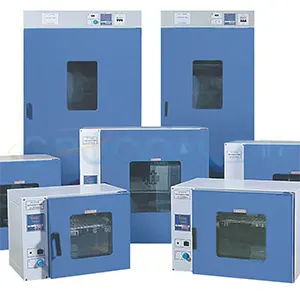
A laboratory drying oven (View HINOTEK Laboratory Drying Oven Catagory) is a fundamental piece of equipment that provides a uniformly heated, enclosed chamber. But what Is a Laboratory Drying Oven, its primary purpose is to remove moisture from samples, materials, and laboratory glassware. The oven creates optimal conditions for evaporation, which speeds up the drying process significantly. This is essential for a wide range of laboratory and industrial procedures, including sample preparation, sterilization, materials testing, and quality control.
The core function of a drying oven is to apply heat through convection or forced air circulation. This process eliminates water, solvents, and other volatile substances from diverse samples. It is important to distinguish a laboratory drying oven from a standard household oven. While both heat an enclosed space, a laboratory oven is engineered for precise temperature control, temperature uniformity, and reproducibility. These specifications are critical for scientific experiments and industrial processes where any deviation can invalidate results. A household oven is designed for cooking and lacks the precision required for controlled moisture removal or sterilization.
The true value of a laboratory drying oven lies not just in its ability to generate heat, but in its capacity to deliver controlled, verifiable, and repeatable heat. The target audience for this equipment is not simply buying a hot box; they are investing in a tool for process control. This principle of control is what justifies the specialized nature of the equipment and is the foundation for achieving reliable, accurate outcomes in scientific and industrial work.
How a Drying Oven Works: The Principles of Heat and Airflow
The basic mechanism of a drying oven is straightforward. First, a material is placed inside the oven’s chamber. The oven is then heated to a specified temperature. This applied heat causes the moisture within the material to evaporate, turning into water vapor. This moisture-laden air is then removed from the chamber and replaced with drier ambient air, which allows the drying process to continue until the sample is completely dry. This is known as the thermogravimetric principle, which is often used to measure the initial moisture content of a sample by weighing it before and after the drying process.
Heat Transfer Mechanisms
Thermal energy is transferred from the oven to the sample through three primary physical principles working in combination.
- Convection: This is the most dominant mode of heat transfer in a drying oven. Electric heating elements warm the air inside the chamber. This hot air then circulates and transfers its heat to the surfaces of the samples. The circulation can be natural, driven by the principle that hot air rises (gravity convection), or it can be assisted by a fan (forced convection).
- Conduction: Once the surface of a sample is heated by the circulating air, that heat energy moves toward the center of the item. This process of heat transfer through direct contact is called conduction. It is particularly important for effectively drying thicker or denser materials.
- Radiation: The hot interior walls of the oven also contribute to the heating process. The walls radiate thermal energy, which is then absorbed by the samples inside the chamber.
The Role of Air Exchange
A key feature that separates a dedicated drying oven from a simple heating oven is its air exchange system. A heating oven may just recirculate the same air internally, which can become saturated with moisture and slow the drying process. A drying oven, however, functions as an active moisture removal system.
Most drying ovens are equipped with adjustable inlet and exhaust ports, typically located on the top or back of the unit.
- The inlet port regulates the amount of fresh, dry ambient air that is drawn into the chamber.
- The exhaust port allows the warm, moisture-saturated air to exit.
This continuous exchange is critical. It prevents the chamber’s atmosphere from reaching a point of humidity saturation, which would stop evaporation. By constantly replacing moist air with dry air, the oven maintains a moisture gradient that actively drives the drying process forward. The rate of this exchange, often measured in air changes per hour, can be adjusted to optimize the drying speed for different materials and applications.
Inside the Box: Key Components of a Laboratory Drying Oven
A high-quality laboratory oven is a well-engineered system where each component is designed to support the others to achieve precise and repeatable results. A failure in one part, such as a poor door seal, can compromise the performance of the entire system, regardless of the quality of its other components.
|
|

The Chamber (or Cavity)
This is the main workspace where samples are placed for drying.
 |
- Materials: The interior chamber of most laboratory ovens is constructed from stainless steel, such as grade 304 or 430. This material is chosen for its excellent corrosion resistance, durability, and because it is easy to clean. The exterior is typically made from powder-coated steel, which provides a durable and resistant finish.
- Design: High-quality ovens often feature rounded internal corners. This design element is important because it prevents the buildup of residue and makes the chamber easier to clean thoroughly, which is critical for preventing cross-contamination between different sample batches.
Heating Elements
Heating elements are the components responsible for converting electrical energy into the thermal energy needed to heat the chamber.
- Types: Common types include coiled or tubular heating elements made from high-resistance materials like nichrome wire. They are designed to provide efficient heat transfer and allow for rapid temperature ramp-up times.
- Placement: The elements are usually located outside the main chamber, often in an external jacket or at the back or bottom of the unit. They are shielded from the samples to prevent direct radiant heating, which could create hot spots and damage sensitive materials. Instead, the heat is transferred to the chamber air, which is then circulated via convection.
The Controller and Temperature Sensor
This system is the “brain” of the oven, responsible for regulating temperature with precision.
- Function: The controller continuously monitors the internal temperature using a sensor, such as a PT-100 probe. It then regulates the power supplied to the heating elements to maintain the desired setpoint temperature.
- PID Control: Modern, high-performance ovens use a Proportional-Integral-Derivative (PID) controller. Unlike a simple on/off thermostat that can cause temperature swings, a PID controller uses a sophisticated algorithm to anticipate heat loss and precisely modulate the power output. This prevents the temperature from overshooting the setpoint and maintains exceptional stability, often within ±0.5°C. Many PID controllers also feature an “autotune” function, which allows the controller to “learn” the thermal characteristics of the oven and its typical load to optimize performance.
Insulation
The space between the inner chamber and the outer casing is filled with high-quality insulation material.
- Materials: Common insulation materials include glass wool or mineral wool.
- Function: Insulation is critical for three main reasons. First, it minimizes heat loss to the surrounding environment, which is essential for maintaining a stable and uniform temperature throughout the chamber. Second, by preventing heat from escaping, it improves the oven’s energy efficiency and reduces operational costs. Third, it ensures operator safety by keeping the exterior surfaces of the oven cool to the touch, preventing accidental burns.
Shelving and Racks
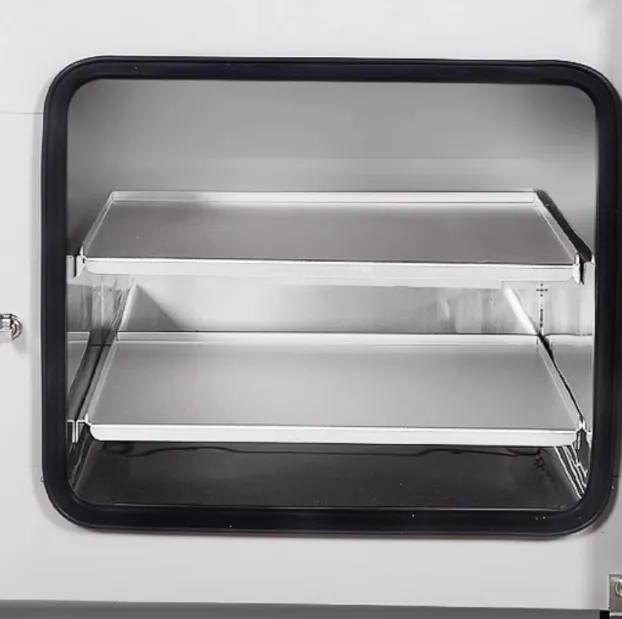 |
These components hold the samples inside the chamber. They are typically made of stainless steel and are designed as either perforated sheets or wire frames. This construction allows for maximum air circulation around the samples, ensuring even and efficient drying. The shelving is usually adjustable to accommodate samples of different sizes and shapes.
Door and Gasket
The door provides access to the chamber and must create a perfect seal to maintain the internal environment.
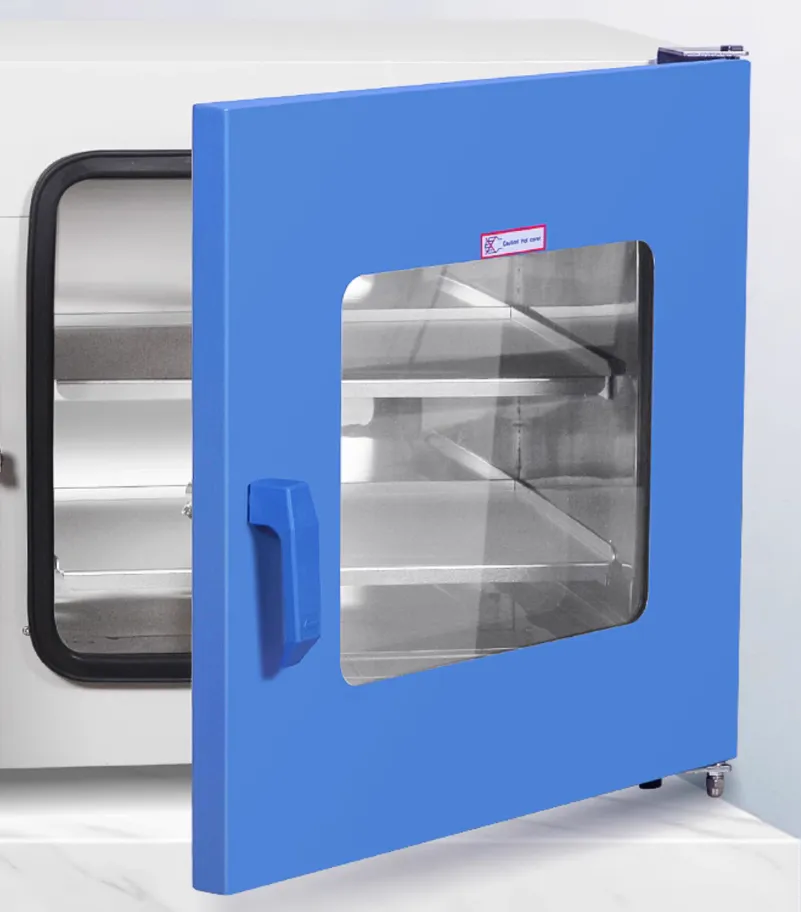 |
- A heat-resistant gasket, often made of silicone or fiberglass, is fitted around the door’s perimeter. This gasket ensures an airtight seal, which is crucial for preventing heat loss and maintaining temperature stability. A damaged or worn gasket can severely compromise the oven’s performance and energy efficiency. Some oven models also feature a double-layer tempered glass window, allowing users to observe samples without opening the door and disrupting the temperature and atmosphere inside.
Types of Laboratory Drying Ovens: Matching the Technology to the Task
Laboratory drying ovens are available in three primary configurations, each using a different method of heat circulation and moisture removal. Selecting the right type depends entirely on the specific application, the nature of the samples being processed, and the required levels of precision and speed.
Natural Convection Drying Oven(Gravity Convection Ovens)
- Principle: These ovens operate on a simple physical principle: hot air is less dense than cool air, so it rises. Heating elements located at the bottom of the chamber warm the air. This heated air rises, transfers its energy to the samples, and then cools, sinks, and is reheated. This process creates a gentle, continuous, and natural airflow cycle without the use of a fan.
- Advantages: The low-turbulence environment is ideal for drying fine powders, lightweight materials, or other samples that could be disturbed or cross-contaminated by a strong fan blast. With fewer mechanical parts, these ovens are generally more economical, quieter, and require less maintenance.
- Disadvantages: Heat transfer is less efficient compared to forced convection models, resulting in longer heat-up and drying times. The natural air currents can also lead to temperature stratification, where the top of the oven is warmer than the bottom. This can create “cold spots” and result in less consistent drying across a large batch of samples.
- Best For: Simple drying applications, processing fine powders or other delicate materials, and situations where absolute temperature uniformity is not the most critical parameter.
Forced-air Convection Drying Oven (Mechanical Convection)
- Principle: These ovens include a motorized fan or blower that actively circulates the heated air throughout the chamber. This forced airflow ensures that heat is distributed much more evenly and efficiently, reaching all corners of the chamber.
- Advantages: The constant air movement minimizes temperature gradients and eliminates hot and cold spots, which leads to excellent temperature uniformity and highly reproducible results. The active heat transfer also significantly speeds up the drying process and allows the oven to recover its setpoint temperature much more quickly after the door has been opened. This level of performance is a requirement for many standardized test methods, such as those from ASTM and AASHTO.
- Disadvantages: The fan’s airflow can be too strong for fine powders or other lightweight samples, potentially blowing them around the chamber. To address this, some advanced models offer adjustable fan speeds. The addition of a fan motor and more complex internal ducting also makes these ovens more expensive to purchase and operate.
- Best For: Applications that demand high temperature uniformity and accuracy, such as materials testing or quality control. They are also ideal for drying multiple samples at once, processing samples with high moisture content, and in any lab where fast turnaround times are important.
Vacuum Ovens
- Principle: Vacuum ovens operate on an entirely different principle. An external vacuum pump is used to remove air from the sealed chamber, creating a low-pressure environment. This reduction in pressure significantly lowers the boiling point of water and other solvents. For example, water boils at 100°C at sea level but can boil at room temperature in a near-vacuum. This allows for rapid drying at much lower temperatures than would be possible in a standard convection oven. Because there is little to no air to circulate, heat is transferred primarily through conduction from the heated shelves directly to the samples.
- Advantages: The ability to dry at low temperatures is essential for heat-sensitive materials, such as pharmaceuticals, biological samples, and certain electronics, which would be damaged or degraded by high heat. By removing air, the vacuum oven also eliminates oxygen, preventing the oxidation of sensitive materials during the heating process. For even greater protection, the chamber can be backfilled with an inert gas like nitrogen.
- Disadvantages: This type of oven requires an external vacuum pump, which adds to the cost, complexity, and footprint of the setup. A cold trap may also be necessary to condense vapors before they reach the pump, protecting it from corrosion. The process is also inherently a batch operation, as loading and unloading requires breaking and re-establishing the vacuum.
- Best For: Drying heat-sensitive or oxygen-sensitive materials, safely removing flammable solvents, degassing liquids and epoxy resins, and processing delicate electronic components.
Comparison of Laboratory Drying Oven Types
The following table summarizes the key characteristics of each oven type to help guide selection.
| Feature | Natural Convection Drying Oven | Forced-air Convection Drying Oven | Vacuum Oven |
|---|---|---|---|
| Operating Principle | Natural air movement (hot air rises, cool air sinks) | Fan-forced air circulation | Reduced pressure lowers the boiling point of liquids |
| Heat Transfer | Primarily convection | Primarily forced convection | Primarily conduction from shelves |
| Temp. Uniformity | Fair to Good | Excellent | Excellent (on shelves) |
| Drying Speed | Slow | Fast | Very Fast (for suitable materials) |
| Temp. Recovery | Slow | Fast | N/A (Batch process) |
| Ideal Applications | Drying fine powders, gentle heating of sensitive samples | High-throughput drying, moisture analysis, sterilization, material testing | Drying heat-sensitive or oxygen-sensitive materials, removing solvents |
| Advantages | Gentle airflow, lower cost, quiet operation | High uniformity, fast drying, rapid recovery | Gentle on samples, prevents oxidation, efficient for complex shapes |
| Limitations | Slower drying, potential for cold spots | Airflow may disturb light samples, higher cost | Requires external vacuum pump, higher initial investment |
Applications: Where Drying Ovens Are Used
Laboratory drying ovens are versatile tools used across a wide spectrum of scientific and industrial fields. While their most basic function is drying, many advanced applications use the oven as a thermal processing chamber to induce specific physical or chemical changes in a material.
General Laboratory and Research
- Glassware Drying: The most common use in any laboratory is the rapid and complete drying of washed glassware like beakers, flasks, and pipettes. This ensures the glassware is ready for reuse quickly and without any residual moisture that could contaminate subsequent experiments.
- Sterilization: Dry heat sterilization is a critical process for materials that cannot withstand the moisture of an autoclave, such as certain metal instruments, powders, oils, and glassware. This method typically requires maintaining a temperature of 160–180°C for one to two hours to effectively kill all microorganisms through oxidation of their cellular components.
- Sample Preparation: In many analytical procedures, drying a biological or chemical sample to a constant weight is a crucial preliminary step. This ensures that measurements from techniques like spectroscopy or chromatography are accurate and reproducible, as moisture content can significantly affect results.
Pharmaceuticals and Biotechnology
- Drying APIs and Excipients: Ovens are used to precisely remove moisture from active pharmaceutical ingredients (APIs) and other components of a drug formulation. This is vital for ensuring the stability, efficacy, and long shelf life of the final product.
- Depyrogenation: This is a high-temperature process, typically conducted around 250°C, used to destroy pyrogens—fever-causing substances like bacterial endotoxins. It is an essential step for sterilizing glassware and equipment used in the manufacturing of sterile injectable drugs.
- Stability Testing: Pharmaceutical companies use drying ovens to perform accelerated aging studies. By exposing drug products to controlled conditions of elevated heat, they can predict the product’s shelf life under normal storage conditions in a much shorter timeframe.
Materials Science and Industrial Quality Control
- Curing: This process uses controlled heat to harden materials such as polymers, adhesives, coatings, and composites. The thermal energy initiates or accelerates chemical reactions that create stronger cross-linked bonds, thereby achieving the desired physical properties like hardness and durability.
- Annealing: This heat treatment process involves heating and then slowly cooling materials like glass or metal. The process relieves internal stresses and refines the material’s crystal structure, making it less brittle and easier to shape or cut.
- Moisture Content Analysis: This is a fundamental quality control step in many industries, including construction (for testing soils and aggregates), textiles, and paper manufacturing. The material is weighed, dried to a constant weight in an oven, and then weighed again. The difference in weight is used to calculate the initial moisture percentage.
Electronics Manufacturing
- Component Drying: Removing even trace amounts of moisture from electronic components like printed circuit boards (PCBs) or semiconductors is critical. Moisture can cause failures such as delamination or corrosion during the high temperatures of the soldering process.
- Die-Bond Curing: Ovens are used to cure the specialized epoxy that attaches a semiconductor die to its package or substrate, ensuring a strong and reliable bond.
- Degassing Epoxy Resins: Before epoxy resins are used to encapsulate sensitive electronic components, they are often processed in a vacuum oven. This removes trapped air bubbles and moisture from the resin, ensuring a void-free seal that protects the component from environmental factors.
Food and Agriculture Industry
- Moisture Determination: The “loss on drying” method, which uses a drying oven, is the industry standard for determining the moisture content of food products like grains, milk powder, and processed foods. Moisture content is a key indicator of product quality, safety, and shelf life.
- Sample Dehydration: Ovens are used to dry agricultural products, such as seeds for long-term storage or plant matter for subsequent chemical analysis, without degrading the sample.
Selecting the Right Drying Oven: A Practical Buyer’s Guide
Choosing the correct laboratory drying oven is a significant investment that impacts lab efficiency, accuracy, and safety. A systematic approach based on application requirements is the best way to make an informed decision.
1. Define Your Application
The first and most important step is to clearly define the primary use for the oven. The answer will immediately narrow the choices.
- Is it for gentle drying of fine powders? A gravity convection oven is likely the best choice.
- Is it for high-throughput quality control testing or drying samples with high moisture content? A forced convection oven will provide the necessary speed and uniformity.
- Is it for processing heat-sensitive biological samples or oxygen-sensitive chemicals? A vacuum oven is required.
2. Temperature Range, Uniformity, and Stability
These are the most critical performance specifications.
- Range: Determine the minimum and maximum temperatures your applications require. Standard ovens typically operate from approximately 10°C above ambient temperature up to 250°C or 300°C. High-temperature models can exceed 500°C. Avoid selecting an oven with a much higher temperature range than you need; these units are more expensive and may offer less stability at lower temperatures.
- Uniformity: This specification measures the temperature consistency at different points within the chamber at a single moment in time (e.g., ±2°C at 150°C). It is the most important factor for ensuring that all samples in a batch receive the same thermal treatment. Poor uniformity leads to inconsistent and unreliable results. Look for manufacturer data from multi-point testing.
- Stability: This measures how well the controller maintains the temperature at a single point over time (e.g., ±0.5°C at 150°C). It reflects the quality of the temperature controller and the oven’s insulation.
3. Chamber Size and Capacity
Select a chamber size that matches your workload.
- Assess the dimensions and volume of your typical sample load.
- Choose a chamber that can accommodate your largest batch without being overcrowded. Overloading restricts airflow and compromises temperature uniformity.
- Avoid buying an oversized oven. It wastes valuable lab space and consumes more energy to heat the unused volume. For smaller labs, compact benchtop models are ideal, and some models can be stacked to conserve floor space.
4. Construction and Materials
The build quality of an oven affects its longevity and performance.
- Interior: A stainless steel interior is the industry standard. It offers excellent durability, resistance to chemical corrosion, and is easy to clean.
- Insulation: Look for models with thick, high-quality insulation and double-wall construction. Good insulation improves energy efficiency, temperature stability, and operator safety by keeping the exterior cool.
5. Safety Features
Safety features are non-negotiable and essential for protecting personnel, samples, and the laboratory itself.
- Over-Temperature Protection: This is a critical feature. It is an independent safety circuit that automatically shuts off power to the heating elements if the main temperature controller fails and the temperature rises above a safe limit.
- Alarms: Look for ovens with visual and audible alarms that alert users to temperature deviations from the setpoint or signal the end of a timed cycle.
- Certifications: Ensure the oven complies with relevant safety standards, such as UL, CE, or DIN 12880.
6. Temperature Recovery Time
This specification measures how long it takes for the oven’s chamber to return to the setpoint temperature after the door has been opened and closed. In high-throughput labs where the door is opened frequently to add or remove samples, a fast recovery time is important to minimize process disruption and maintain efficiency. Forced convection ovens have significantly faster temperature recovery times than gravity convection models.
Operating Your Drying Oven: Best Practices for Safety and Performance
Proper operation and maintenance are essential for ensuring the longevity, performance, and safety of a laboratory drying oven. Following established best practices protects both the user and the integrity of the experimental results.
Safe Operating Procedures
- Personal Protective Equipment (PPE): Always use appropriate PPE. This includes heat-resistant gloves, safety glasses, and a lab coat when loading or unloading the oven. Hot glassware looks identical to cold glassware, so never handle items from an oven without protection.
- Know Your Sample: Never place flammable, volatile, or explosive substances in a standard drying oven, as this can create a fire or explosion hazard. Be aware of the auto-ignition temperature of your materials. Glassware that has been rinsed with organic solvents must be thoroughly rinsed again with distilled water before being placed in the oven.
- Proper Placement and Ventilation: The oven should be situated in a well-ventilated area, away from any combustible materials. Maintain several inches of clearance between the oven and any walls or other equipment to allow for proper air circulation and heat dissipation. If there is a possibility of generating hazardous fumes, the oven should be placed inside a fume hood or connected directly to an exhaust system.
- Opening the Door: When opening a hot oven, always stand to one side. This prevents a direct blast of hot air and potential vapors from hitting your face.
Best Practices for Loading Samples
- Do Not Overload: Overcrowding the chamber is a common mistake that restricts airflow. This leads to poor temperature uniformity and inefficient drying, meaning some samples may be under-dried while others are overheated.
- Distribute Evenly: Spread your samples evenly across all available shelves. Do not concentrate the entire load on a single shelf.
- Maintain Clearance: Leave adequate space between individual samples and between the samples and the chamber walls. This allows air to circulate freely and ensures all surfaces are heated evenly.
- Do Not Block Vents or Sensors: Be careful not to place samples where they might obstruct internal air vents or the main temperature sensor. Blocking these can disrupt performance and lead to inaccurate temperature readings.
- Avoid the Floor: Never place samples directly on the floor of the oven chamber. This can block heating elements, cause localized overheating, and create a fire hazard.
Cleaning and Maintenance
- Routine Cleaning: A regular cleaning schedule is vital. After the oven has cooled completely, wipe the interior surfaces with a soft cloth and a mild detergent. Isopropyl alcohol or simple soap and water are often recommended. Avoid using abrasive pads or chlorine-based cleaners, as these can damage the stainless steel surface.
- Gasket Inspection: Periodically inspect the door gasket for any signs of cracking, brittleness, or damage. A proper seal is essential for temperature stability and energy efficiency. Replace worn gaskets immediately.
- Preventative Maintenance: Establish a routine schedule for inspecting key components like electrical wiring, fan motors, and safety features. A well-maintained oven is safer, more reliable, and will have a longer service life.
Calibration
- Why Calibrate: Over time, the temperature sensor and controller can drift, causing the displayed temperature to differ from the actual temperature inside the chamber. Regular calibration is crucial for ensuring accuracy, which is a requirement in regulated environments (like those following GMP) and for achieving reproducible research results.
- Procedure: Calibration typically involves placing a calibrated, independent temperature probe (such as a thermocouple) in the center of the chamber. The oven is set to a specific temperature and allowed to stabilize. The reading from the independent probe is then compared to the oven’s display. If there is a significant discrepancy, the oven’s controller should be adjusted according to the manufacturer’s instructions. This process should generally be performed at least annually.
Drying Oven vs. Other Lab Equipment: Clearing the Confusion
Choosing the right tool for a specific job is critical in a laboratory setting. Using the wrong piece of thermal equipment can ruin samples, produce invalid data, and even create safety hazards. Here is a clear comparison between a drying oven and other common laboratory heating devices.
Drying Oven vs. Incubator
- Primary Difference: Temperature Range and Purpose. The most fundamental difference is their intended use. An incubator is designed to grow and maintain biological cultures, such as cells or bacteria. It operates at lower, near-physiological temperatures, typically from just above ambient to around 80°C, with 37°C being a common setpoint. A drying oven operates at much higher temperatures (up to 300°C or more) and is designed to sterilize or remove moisture—conditions that would kill the very cultures grown in an incubator.
- Environmental Control: Incubators often include additional controls for humidity and CO2 levels, which are necessary to maintain the optimal pH and environment for cell growth. Drying ovens lack these features.
Drying Oven vs. Muffle Furnace
- Primary Difference: Maximum Temperature and Heating Mechanism. This is the key distinction. A drying oven is a low-to-mid-temperature device, typically maxing out around 300°C, with some models reaching 600°C. A muffle furnace is a high-temperature unit designed for applications like ashing samples, sintering ceramics, or heat-treating metals. It can reach temperatures of 1000°C to 1800°C.
- Heat Transfer: Drying ovens primarily use convection (circulating hot air) to heat samples. Muffle furnaces use intense radiant heat. Their heating elements are embedded in a thermally insulating material (the “muffle”) that isolates the sample from direct contact with the elements, providing extremely high and uniform heat.
Drying Oven vs. Autoclave
- Primary Difference: Sterilization Method. This comparison applies specifically to sterilization. A drying oven uses dry heat. An autoclave uses moist heat in the form of high-pressure steam, typically at 121°C and 15 psi.
- Effectiveness and Speed: Moist heat is a more efficient sterilizing agent than dry heat. It penetrates materials more effectively and kills microorganisms at lower temperatures and in much shorter times (15–30 minutes for an autoclave versus 1–2 hours for a dry heat oven).
- Material Compatibility: The choice between them often comes down to the material being sterilized. Autoclaves are ideal for liquids, culture media, and most surgical instruments. Dry heat ovens are necessary for materials that are sensitive to moisture or cannot be penetrated by steam, such as powders, oils, fats, and sharp metal instruments that could be corroded or dulled by steam.
If you are ready to find the right Drying Oven for your laboratory after study our this article “What Is a Laboratory Drying Oven”, please browse our complete product range: Laboratory Drying Oven
This guide is maintained by HINOTEK’s core technical team, comprised of senior engineers and application scientists with over two decades of hands-on experience in fields such as microscopy, centrifugation, and spectrophotometry. We are committed to ensuring that every piece of information in this guide—from instrument principles and technical specifications to laboratory procurement advice—maintains the highest level of accuracy and timeliness.
This content is regularly reviewed and updated to reflect the latest industry standards and technological advancements. We value feedback from the global scientific community. Should you have any questions or suggestions, or wish to discuss any technical details, please do not hesitate to contact our expert team at [email protected].
Works cited
- What is a Drying Oven | Discover Industrial Drying Ovens & Drying Furnace Applications from SentroTech, https://www.sentrotech.com/applications/drying-furnaces-ovens/
- What are Lab Drying Ovens Used For? – XRF Scientific, https://www.xrfscientific.com/what-are-lab-drying-ovens/
- Guide About A Drying Oven – MRC Lab, https://www.mrclab.com/guide-about-a-drying-oven
- Drying Oven – American Society of Brewing Chemists,https://www.asbcnet.org/lab/samplingplan/tools/Pages/DryingOven.aspx
- DETERMINATION OF MOISTURE AND TOTAL SOLIDS, https://people.umass.edu/~mcclemen/581Moisture.html
- Incubators vs Lab Ovens vs Lab Furnace – The Lab World Group, https://www.thelabworldgroup.com/blog/incubators-vs-lab-ovens-vs-lab-furnace/
- Difference between incubator and oven | FG, https://fginst.com/difference-between-incubator-and-oven/
- Laboratory Ovens: Uses and Benefits – Despatch Industries, https://www.despatch.com/blog/what-are-laboratory-ovens-used-for/
- Hot Air Oven: Principle, Parts, Types, Uses, Examples – Microbe Notes, https://microbenotes.com/hot-air-oven/
- Lab Oven Features | Thermo Fisher Scientific – ES, https://www.thermofisher.com/es/en/home/life-science/lab-equipment/lab-ovens-furnaces/lab-ovens/features.html
- What is a moisture analyzer? How do balances, ovens, titrations and NIR compare?, https://aqualab.com/en/knowledge-base/expertise-library/what-moisture-analyzer-how-do-balances-ovens-titrations-and-nir
- Moisture Methods – Cereals & Grains Association, https://www.cerealsgrains.org/resources/Methods/Pages/44Moisture.aspx