
 |
A practical laboratory guide to polarimeter working principles, zero calibration, sample measurement, and important precautions for accurate optical rotation and specific rotation analysis.
Overview
When plane-polarized light passes through a liquid or solution containing certain optically active compounds, the plane of polarization may rotate to the left or to the right. This phenomenon is known as optical rotation, and the angle of rotation is called the optical rotation angle.
Under a specified wavelength and temperature, when polarized light passes through a solution containing 1 g of optically active substance per 1 mL with an optical path length of 1 dm, the measured rotation is called specific rotation. Specific rotation, or optical rotation, can be used to identify optically active substances, evaluate purity, detect impurities, and determine the content of optically active pharmaceutical compounds.
Part 1. Working Principle of a Polarimeter
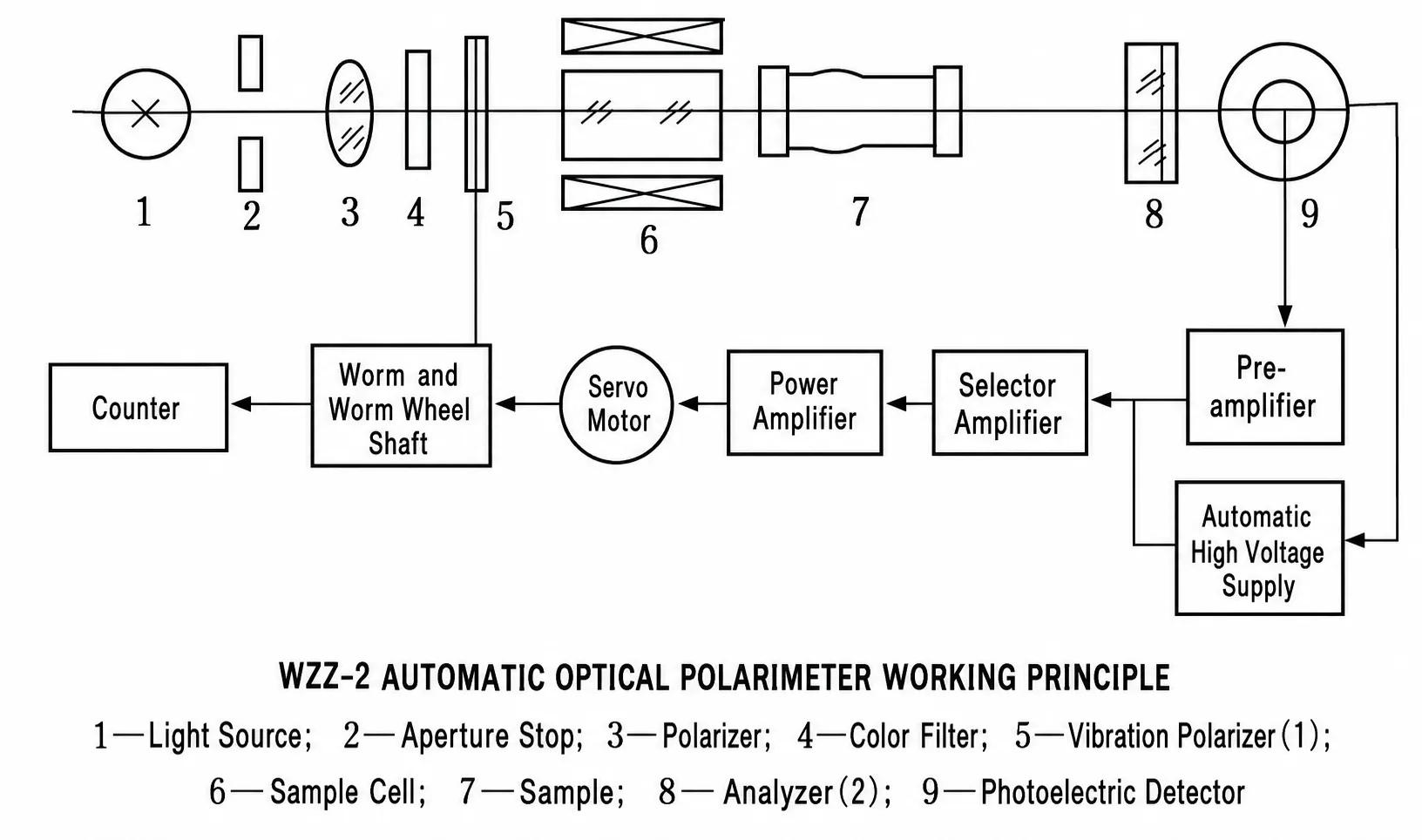 |
After a test tube containing the sample solution is placed in the measuring chamber, the optically active solution rotates the plane of polarized light by a certain angle. As a result, the original zero-degree field of view changes.
By rotating the analyzer through a corresponding angle, a field of view with uniform brightness can be obtained again. This rotation angle is the optical rotation of the solution. Once the optical rotation is measured, the specific rotation of the substance can be calculated. Based on the specific rotation value, the purity and concentration of the substance can be determined.
Part 2. Operating Procedure
- Turn on the power switch. After the sodium lamp lights up, allow it to warm up for 15–30 minutes until the light output becomes stable before starting measurement.
- If the sodium lamp does not light after switching on the light source, toggle the light source switch up and down 1–2 times until the sodium lamp lights normally under DC power.
- Turn on the measurement switch. The instrument will enter standby measurement mode, and numbers should appear in the digital display window.
- Use deionized water or another blank solvent to rinse the sample tube 2–3 times. After temperature equilibration, perform zero calibration of the instrument.
- Pour out the blank solvent. Rinse the sample tube 2–3 times with the prepared sample solution, then fill the sample tube with the sample and place it in the sample chamber. Use the same position and direction as during zero calibration, then close the chamber cover. The digital display will show the optical rotation of the sample. Press the repeat-measurement button successively and read the value 2–3 times. Use the average value as the final test result.
- After testing, pour out the sample solution from the sample tube, rinse the tube thoroughly with purified water, and then turn off the instrument.
Part 3. Zero Calibration
- Place the polarimeter tube filled with deionized water or another blank solvent into the sample chamber and close the chamber cover. When the reading in the digital display window becomes stable, press the zero button.
- If there are bubbles in the polarimeter tube, move the bubbles to the bulged neck area of the tube.
- If fog-like water droplets appear on the light-transmitting glass surfaces at both ends of the tube, wipe them dry with lens paper.
- Do not tighten the screw caps of the polarimeter tube excessively. This helps prevent the glass plates from breaking and also avoids measurement errors caused by “false polarization” resulting from stress in the optical glass.
- For every measurement, place the polarimeter tube in the same position and direction.
Part 4. Precautions for Accurate Polarimeter Measurement
- Before measurement, place the polarimeter and the sample in a constant-temperature room at 20°C ± 0.5°C, or in a constant-temperature room at the specified temperature. A constant-temperature water bath may also be used to keep the sample chamber or sample tube at a stable temperature for more than 1 hour. This is especially important for optically active substances that are highly sensitive to temperature.
- Before switching on the power, check whether there are foreign objects in the sample chamber, whether the sodium lamp source switch is in the required position, whether the display switch is off, and whether the instrument is placed in a suitable location. Do not move the instrument after the sodium lamp has started.
- After the sodium lamp is turned on, it normally requires at least 20 minutes to stabilize. During measurement, use DC power for the sodium lamp whenever possible to maintain stable brightness. If the instrument has a polarity switch, change the polarity regularly after shutting down the instrument to extend the service life of the sodium lamp.
- Before measurement, when zeroing the polarimeter, repeatedly press the repeat-measurement switch so that the analyzer deviates from the optical zero position to the left and right. By observing the stopping points of the left and right repeat measurements, the repeatability and stability of the instrument can be checked. If the error exceeds the specified limit, the instrument should be serviced before use.
- Place the measuring tube filled with distilled water or blank solvent into the sample chamber. If bubbles are present in the measuring tube, first move them to the bulged neck area. Wipe the glass surfaces at both ends of the optical path dry with a soft cloth. During measurement, keep the position and direction of the measuring tube as consistent as possible and mark it if necessary. This helps reduce errors caused by stress in the measuring tube and cover glass.
- When the same optically active substance is measured using different solvents or at different pH values, its specific rotation may change due to differences in association, solvation, and dissociation. In some cases, the optical rotation direction may even reverse. Therefore, the specified solvent must be used.
- Turbid solutions or solutions containing small particles cannot be measured directly. The solution must first be centrifuged or filtered, and the initial filtrate should be discarded before measurement. For substances whose optical rotation changes significantly after exposure to light, protect the sample from light during operation. For samples whose optical rotation is strongly affected by storage time, readings must be taken within the specified time.
- Whether measuring the blank zero point or the stopping point of the test solution, take three readings and calculate the average. For strict measurements, zero calibration with the blank solvent should be performed before each measurement. After measurement, check the zero point again with the reagent. If the zero point changes significantly, the test should be repeated.
- After measurement, clean the measuring tube, allow it to dry, and return it to its original storage position. Keep the instrument away from dust and store it in a dry environment. A small amount of desiccant may be placed in the sample chamber to prevent moisture.
Typical Applications
Polarimeters are widely used in laboratories where optical activity must be measured accurately and repeatably. They are especially useful for quality control, teaching laboratories, pharmaceutical inspection, and chemical production.
Pharmaceutical Analysis
Identification, purity inspection, and content determination of optically active pharmaceutical ingredients.
Food and Sugar Testing
Measurement of sugar concentration and optical rotation in food, beverage, and sugar industry laboratories.
Chemical Quality Control
Routine QC analysis of chiral compounds, solvents, reaction products, and research samples.
Need More information of Polarimeter?
Visit our page: What is a polarimeter.
Need a Laboratory Polarimeter?
HINOTEK supplies laboratory and scientific instruments for education, research, pharmaceutical testing, and industrial quality control. Contact us for polarimeter specifications, configuration options, and quotation support.