
Centrifuge RPM vs. RCF (×g): Understanding the Difference and Essential Balancing Tips
When reviewing scientific literature, researchers often encounter two parameters for centrifugation: RCF (×g) and RPM. What is the critical difference between them? What are the common types of centrifuge rotors, and how must they be balanced for safe operation? This article explores these essential questions about laboratory centrifugation.
 |
1. RCF and RPM Defined
-
RCF (Relative Centrifugal Force): RCF, expressed in units of gravity (×g), is the standard unit of force exerted on the sample during centrifugation. It represents the actual force the sample experiences.
-
RPM (Revolutions Per Minute): RPM is the unit for the centrifuge’s rotational speed, indicating how many times the rotor completes a full rotation per minute.
2. The RCF and RPM Conversion Relationship
The g-force (RCF) is related to the speed (RPM) and the rotor’s radius using the following formula:
RCF = (RPM)2 × 1.118 × 10 -5 × r
Where r is the effective radius of centrifugation (in centimeters).
While online calculators are available for this conversion, the key takeaway is that RCF, not RPM, is the reproducible measure.
Because different centrifuge models and rotors have different radii, the same RPM setting will produce a different RCF (force). Therefore, to ensure experimental reproducibility, protocols and publications should always specify the RCF (×g).
HINOTEK provides Online Calculators.
Understanding Centrifuge Rotor Types
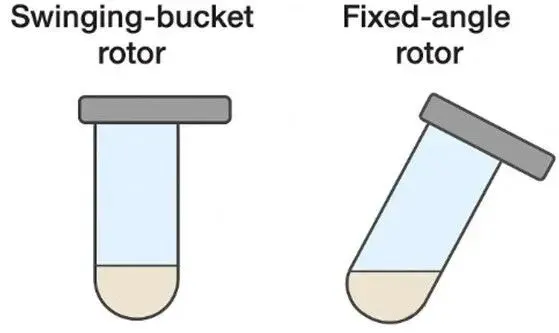
A single centrifuge unit can often accommodate multiple rotors. Based on experimental design, centrifuge rotors are primarily divided into two categories: swinging-bucket rotors and fixed-angle rotors.
 |
Swinging-Bucket Rotors (or Horizontal Rotors)
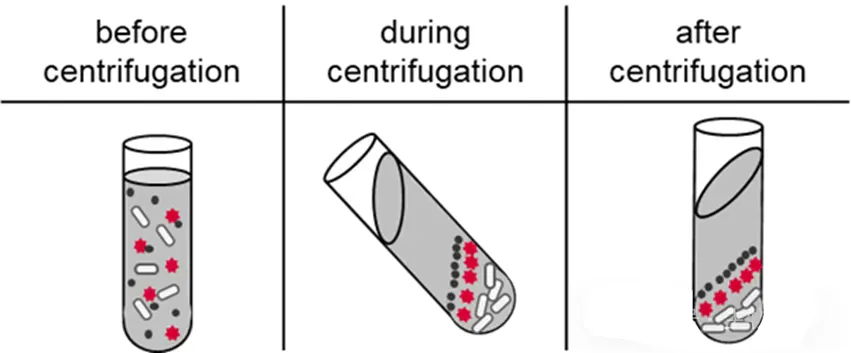
In a swinging-bucket rotor, the centrifuge tubes are held in buckets that are vertical when the rotor is at rest. As the centrifugation begins, the buckets swing out to a horizontal (or near-horizontal) position.
-
Advantages: This design allows particles to settle at the bottom of the tube, forming a flat, even pellet interface.
-
Applications: Because they maintain clear separation layers, swinging-bucket rotors are ideal for density gradient centrifugation, such as the separation of nucleic acids, virus particles, or cellular organelles.
-
Limitation: They generally have lower maximum speeds and RCF capabilities compared to fixed-angle rotors.
 |
Fixed-Angle Rotors (or Angle Rotors)
In a fixed-angle rotor, the centrifuge tubes are held at a static, fixed angle (typically 20° to 45°) and do not swing during the run.
-
Mechanism: Particles travel outward and settle against the side wall of the tube, forming a slanted pellet.
-
Advantages: Fixed-angle rotors can withstand much higher rotational speeds and RCFs.
-
Applications: They are commonly used for differential centrifugation (pelleting) to collect precipitates like cells, plasmid DNA, and proteins. This is the most frequently used rotor type in a typical lab setting.
 |
Quick Tips for Balancing Your Centrifuge
Proper balancing is essential for safe operation and to prevent damage to the centrifuge.
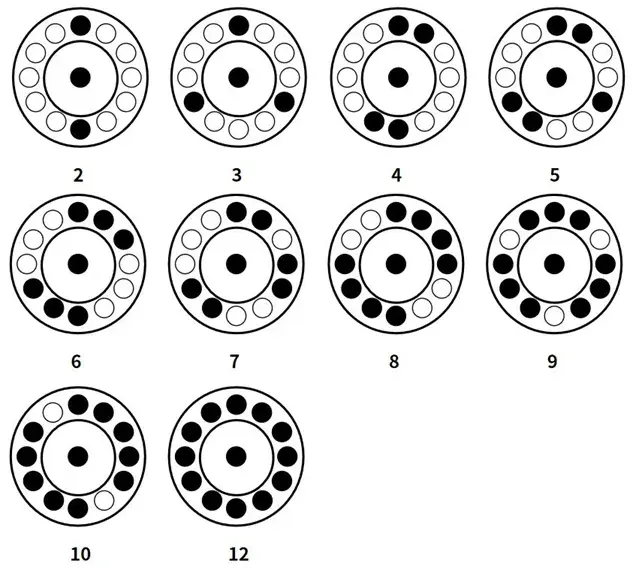
1. 12-Place Fixed-Angle Rotor
For a 12-place rotor, always follow the principle of point symmetry (or rotational symmetry). Tubes must be placed directly opposite each other, or in a balanced pattern (e.g., 2, 3, 4, or 6 tubes) where the mass is distributed symmetrically around the center.
 |
2. 24-Place Fixed-Angle Rotor
-
-
Even numbers (n=2, 4, 6…): Place tubes diametrically opposite each other (axial symmetry). Multiples of 3 (n=3, 6, 9…): Place tubes in an equidistant triangular (or hexagonal) formation, as shown in the diagram:
-
 |
-
Odd numbers (n=5, 7, 11…): This requires a “combination” method, such as balancing a 3-tube pattern and a 2-tube pattern (for 5 tubes), ensuring the total mass is centered. Always refer to the manufacturer’s diagram for these complex patterns.
 |
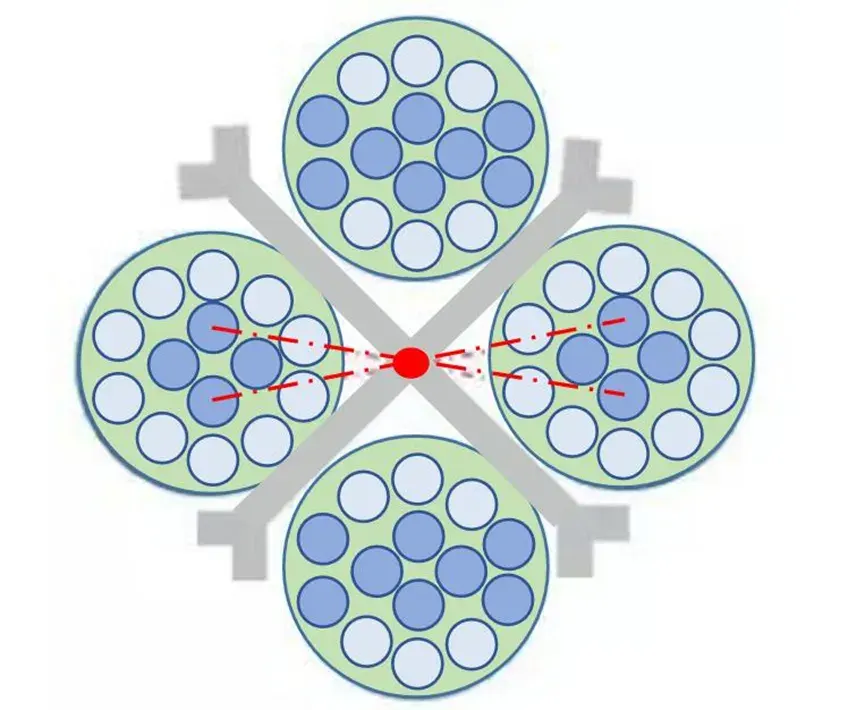
3. Swinging-Bucket Rotor
Balancing these rotors has two requirements:
-
The tubes within an individual bucket must be balanced (if using multiple tubes).
-
The bucket itself must be balanced with the bucket on the diametrically opposite side. (Ensure the buckets, adapters, and tubes all have matching weights).
 |
Find the Right Centrifuge for Your Laboratory
Understanding the principles of RCF, RPM, and rotor types is the first step. The next is equipping your lab with a reliable, high-performance centrifuge.
- To purchase a laboratory centrifuge: HINOTEK offers a comprehensive range of centrifuges designed for precision and durability. Explore our full product line here:https://www.hinotek.com/product-category/product/lab-centrifuge/
- To learn more about centrifuge technology: For a deeper dive into what a centrifuge is and its applications, visit our detailed informational guide:https://www.hinotek.com/what-is-centrifuges/