
 |
By HINOTEK Technical Editorial Team | Understanding the Mechanics of Consistent Research
The Mystery of the “Off-Center” Stir Bar
While synthesizing palladium nanoparticles in chloroform, Ananikov’s team faced a nightmare: inconsistent nanoparticle sizes despite identical conditions. Even when six identical vessels were placed on the same multi-position stirrer, the results varied wildly.
“The secret wasn’t in the reagents, but in the physical coordinates of the reaction vessel on the stirrer plate.”
Using 3D-printed racks and time-lapse photography, the team discovered that off-center positioning causes the magnetic stir bar to tilt. This slight tilt triggers a chain reaction:
- Mechanical Grinding: The tilted bar grinds against the vessel walls, altering the surface area of catalysts like carbon nanotubes.
- Glassware Damage: Micro-scratches on the glass surface become “impurity traps” that are nearly impossible to clean.
- Stirring Failure: In vessels furthest from the center, stir bars often stop rotating entirely within 60 seconds.
The “Traffic Light” Zones of Stirring Efficiency
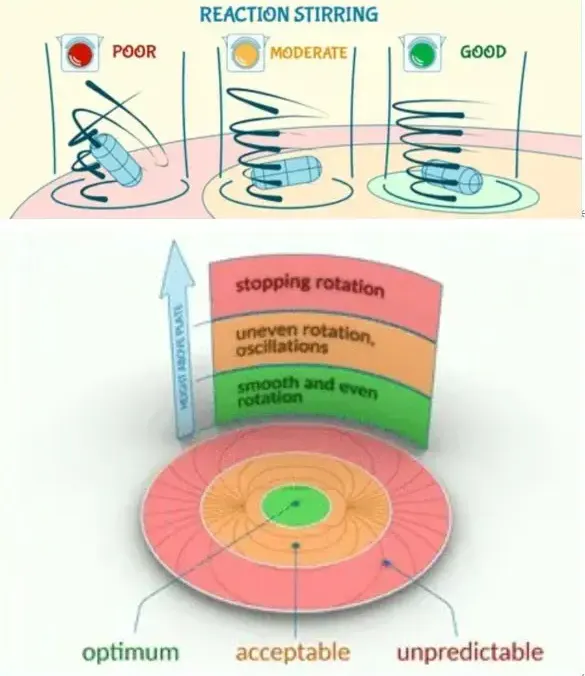 |
Ananikov categorized the space above a magnetic stirrer into three critical zones to help researchers ensure uniformity and reproducibility:
| Zone | Characteristics | Recommended Use |
|---|---|---|
| Green Zone | Stable, high-efficiency rotation. (Radius < 1/2 of stir bar length) | Critical quantitative analysis |
| Yellow Zone | Oscillating or irregular patterns. (6–12 cm vertical height) | Rough condition screening |
| Red Zone | Bar stalls or presses against walls. | Avoid (leads to failed experiments) |
The Hidden Danger: Cross-Contamination in Old Stir Bars
This wasn’t Ananikov’s first encounter with stir bar issues. In a 2019 study published in ACS Catalysis, he examined 60 used stir bars under an electron microscope. The surfaces were riddled with pits and cracks harboring residual metal nanoparticles.
 |
In one shocking test, an old stir bar that had previously been used with palladium acted as a catalyst on its own, achieving yields comparable to adding fresh catalyst. For high-precision labs, a “dirty” stir bar is a ghost in the machine that can ruin months of work.
To understand the fundamental principles common to all types of Magnetic Mixer, be sure to read our main article: How does a magnetic stirrer work: The Ultimate Guide to Magnetic Stirrers: How They Work, Types, and Uses.