
 |
|

Peristaltic Pump vs Diaphragm Pump: Who Rules Biopharmaceutical Fluid Transfer?
Fluid transfer is a cornerstone operation in modern biopharmaceutical upstream and downstream processing. It is far more than a simple mechanical movement of liquids; it directly influences cell viability, protein structural integrity, and the ultimate sterility and consistency of the final biological product.
Peristaltic pumps and diaphragm pumps are the two most widely utilized fluid handling solutions in bioprocessing. This technical review provides a systematic, comparative analysis of both technologies—examining their working principles, core advantages, and inherent limitations to help lab managers and global distributors make informed procurement decisions.
1. Peristaltic Pumps
A typical laboratory or industrial peristaltic pump consists of three essential components: a motor drive unit, a pump head, and elastomeric, flexible tubing.
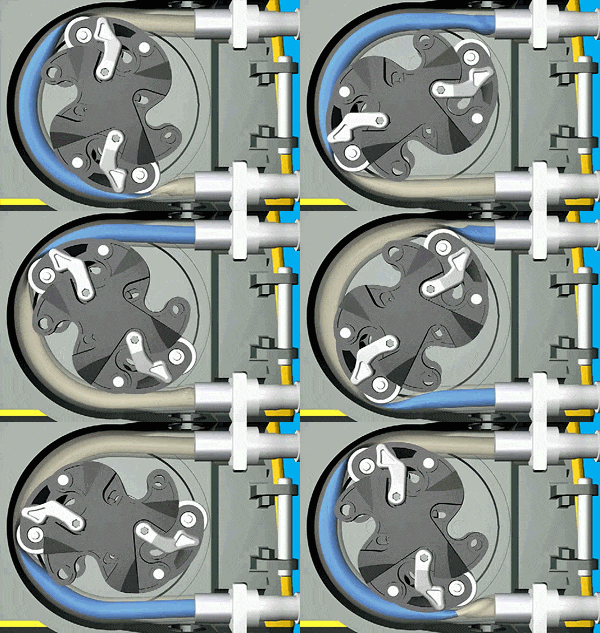
Working Principle: Peristaltic pumps achieve continuous fluid displacement by utilizing a motor-driven roller or shoe assembly to alternately compress and release the flexible tubing. As the roller moves along the tube, it seals the tubing and forces the trapped fluid forward. When the roller passes, the natural elasticity of the tubing causes it to recover its original shape, creating a vacuum (negative pressure) that draws subsequent fluid into the channel.
Common configurations include variable-speed, flow-rate calibrated, dispensing, and customized OEM peristaltic pumps. Each type offers unique operating characteristics tailored to specific application scenarios, with the ultimate goal of achieving ultra-precise volumetric flow control.
Key Advantages of Peristaltic Pumps
- Zero Cross-Contamination Risk: The unique design ensures the fluid solely contacts the inner liner of the tubing, never coming into contact with the pump body itself. Simply switching the single-use assembly or tubing line allows for rapid product changeovers, eliminating the need for complex and costly cleaning validation (CIP/SIP) in high-purity sterile environments.
- High Cleanliness & Sterility: Pre-sterilized tubing assemblies (e.g., gamma-irradiated) are ready-to-use out of the box. The fluid path contains no valves, seals, or dead legs, drastically reducing areas where microbial bioburden can accumulate.
- Simplified Maintenance: Lacking internal valves and mechanical seals, the structural design is remarkably simple. This reduces mechanical failure rates, minimizes maintenance overhead, and limits operational downtime during intensive industrial or laboratory schedules.
- Ultra-Low Shear Force: Peristaltic action exerts minimal shear stress on the fluid. This gently handles sensitive biomolecules, maintaining the structural stability of live cells, delicate proteins, and complex biological fluids without causing degradation.
- Excellent Chemical Compatibility: Because the fluid is completely isolated within the tube, chemical resistance depends entirely on the tubing material. It can easily handle highly corrosive fluids, organic solvents, and aggressive acids.
Limitations of Peristaltic Pumps
- Tubing Degradation & Spallation: Under continuous compression from rollers, the elastomeric tubing suffers from mechanical fatigue and wear. Standard silicone tubing typically has a working lifespan of only 200–500 hours. Frequent replacement increases consumables costs and introduces a risk of spallation (shedding of plastic particulates into the fluid stream).
- Limited Flow Rate and Discharge Pressure: Peristaltic pumps generally operate at lower delivery pressures (typically output pressure < 6 bar) and moderate flow rates. They are unsuitable for large-scale production or high-pressure operations such as deep tangential flow filtration (TFF). Additionally, the cyclical contact of the rollers introduces a pulsating flow profile.
- Flow Rate Decay Uncertainty: Variability between different pump heads and tubing batches can cause slight deviations in flow calibration. Over long periods, as the tubing loses its mechanical elasticity, the flow rate gradually decays, which may compromise applications requiring strict, uncalibrated long-term precision.
- Temperature Sensitivities: The polymer tubing is highly sensitive to extreme temperatures. High temperatures soften the material, causing deformation, while low temperatures render the tubing brittle and prone to rupture. Furthermore, high-speed friction between the roller and the tube can generate localized heat, potentially threatening heat-sensitive protein therapeutics.
- Risk of Protein Particle Aggregation: Peer-reviewed studies indicate that peristaltic pumping can trigger protein particle formation. This occurs via interfacial adsorption; proteins form a thin film on the inner tubing wall, which is repeatedly sheared and torn away by the rolling action, causing microscopic protein fragments to aggregate into the bulk solution.
2. Diaphragm Pumps
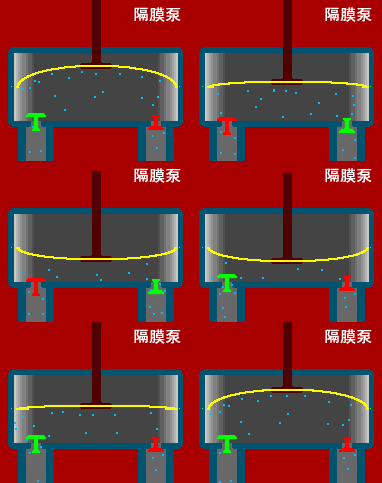
Working Principle: Diaphragm pumps operate via a reciprocating mechanism. Driven by an internal motor or compressed air, a plunger or piston moves back and forth, transferring kinetic energy to a flexible diaphragm. This reciprocating motion continually alters the internal volume of the pump chamber through two alternating phases:
- Suction Phase: The diaphragm moves backward, expanding the pump chamber’s volume and generating negative pressure, which draws the fluid in through the inlet check valve.
- Discharge Phase: The diaphragm forces forward, contracting the chamber’s volume, increasing internal pressure, and expelling the fluid out through the outlet check valve.
Depending on the driving power source, diaphragm pumps are classified into three types: Air-Operated Double Diaphragm (AODD) pumps, Electric Diaphragm pumps, and Hydraulic Diaphragm pumps. Among these, Electric Diaphragm pumps are widely favored in food processing, water treatment, and pharma for applications demanding continuous operation and automated flow control.
Key Advantages of Diaphragm Pumps
- Broad Fluid Handling Capability: Diaphragm pumps are highly versatile and capable of handling high-viscosity fluids, volatile liquids, slurs containing solid particles, and toxic substances at much higher discharge pressures than peristaltic pumps. Advanced diaphragms made from PTFE, nitrile, neoprene, or Viton offer comprehensive chemical compatibility across heavy-duty industrial applications.
- Superior Hermetic Safety: Designed without dynamic shaft seals, diaphragm pumps provide a leak-free, hermetically sealed operational flow path. This configuration minimizes any risk of hazardous fluid leakage, protecting the environment and laboratory personnel from volatile or toxic chemical exposure.
- Self-Priming and Dry-Running Capabilities: These pumps can run dry for extended periods without damaging the internal pump mechanics. They exhibit outstanding suction lift capabilities (up to 7 meters static head) without requiring manual priming. Built-in overload protection mechanisms auto-shut down the unit during blockages and resume once normal conditions return.
- Long-Term Cost Efficiency: The heavy-duty metallic or plastic pump body typically features a service life exceeding 50,000 operational hours. Maintenance intervals for standard diaphragms range from 6 to 12 months, which is significantly longer than the 200–500 hour tubing replacement cycle required by peristaltic alternatives.
Limitations of Diaphragm Pumps
- High Cleaning and Validation Costs: The multi-use internal chamber and check-valve structures (such as ball valves and seats) possess geometric dead spaces. This presents high risks of fluid entrapment, requiring rigorous, extensive Clean-In-Place (CIP) and sterile validation protocols.
- Pulsation and Flow Fluctuations: Due to the reciprocating movement of the diaphragm, the output fluid stream exhibits natural pulsations rather than a perfectly smooth linear flow, often requiring external pulsation dampeners.
- Localized Shear Risk: While the overall chamber environment is low-shear, localized high-shear zones occur at the precise moments when the inlet/outlet check valves open and close. This can compromise the structural integrity of shear-sensitive biopharma proteins or monoclonal antibodies.
- Higher Energy Footprint: Standard AODD setups require a continuous supply of compressed air, making them energy-intensive. Electric variations are more efficient but still show significant power draw under peak load and high pressure.
Peristaltic Pump vs Diaphragm Pump: Side-by-Side Comparison
To assist global scientific instrument distributors, B2B procurement managers, and laboratory research teams in selecting the optimal system, the technical specifications are consolidated below:
| Evaluation Metric | Peristaltic Pump | Diaphragm Pump |
|
Contamination Prevention |
Fluid only contacts the tubing, single-use capability, zero risk of cross-contamination. | ❌ Diaphragm, valves, and pump chamber require CIP/SIP; carries contamination risks due to structural dead legs. |
|
Shear Force |
Extremely low shear force (no impellers or gears); ideal for sensitive media like live cells and proteins. | ⚠️ Relatively low shear force (reciprocating diaphragm motion + transient shear at the valves); may damage fragile cells. |
|
Pressure Range |
❌ Low pressure (typically < 10 bar); pressure tolerance is limited by the elastomeric tubing. | Medium to high pressure (up to dozens of bar); ideal for high-pressure applications like filtration. |
|
Flow Accuracy |
High accuracy (±0.5%), but exhibits higher uncertainty regarding flow rate decay over time. | ⚠️ Medium accuracy (±2%); flow pulsation requires dampener compensation. |
|
Maintenance Cost |
❌ Tubing requires regular replacement (typically every 200–500 hours), leading to high long-term consumable costs. | Long lifespan for diaphragms and valves (typically thousands of hours), though replacement is complex (requires pump body disassembly). |
|
Media Adaptability |
⚠️ Suitable for various liquids depending on tubing material, but limited under high viscosity (typically ≤ 5000 cP), presence of particles, or extreme temperature conditions. | Highly versatile; naturally engineered to handle a wider range of challenging liquid conditions.
|
For an easy-to-understand overview of Diaphragm Vacuum Pump & peristaltic pump, visit our page: How Does A Diaphragm Vacuum Pump Work? & What is a peristaltic pump?