
- Introduction
Pipettes are essential tools in modern laboratories. Beyond chemical analysis, they are extensively used in biology, medicine, environmental science, and food safety labs, with a massive volume of consumption. As an instrument exporter, HINOTEK offers various types of pipettes.
Currently, imported pipettes are expensive; brands like Gilson, Eppendorf, and Rainin generally cost between 1,000 to 2,000 RMB per unit. The most prominent domestic brand is DLAB, priced at approximately 1/10th of imported brands. Additionally, there are numerous second-tier domestic brands priced under 100 RMB, which are exceptionally affordable. While the mechanical principle of a pipette is simple and has low barriers to entry regarding materials and manufacturing, laboratory supplies demand stability and reliability. This requires precision craftsmanship and data accuracy rather than a sole focus on low cost.
This study presents a comparative evaluation of 5mL pipettes from Gilson, DLAB, and six other domestic brands. The primary objectives are:
- To provide an objective understanding of the quality of domestic brands, moving beyond the “cheap goods” stereotype.
- To clarify evaluation methodologies so users can “purchase with insight and use with clarity.”
- Test Subjects
All pipettes selected for this evaluation have a 5mL volume range.
- Imported Representative: Gilson (France).
- Domestic Tier 1 Representative: DLAB (Beijing). (These were selected simply because they were available in our laboratory.)
- Other Domestic Brands: Six brands were randomly selected based on ease of purchase via JD.com (all priced under 100 RMB).
Note: The selection was entirely random and objective, intended to represent the overall level of domestic pipettes rather than targeting specific brands. The author has no conflict of interest with any of these brands. Unauthorized use of this content for commercial promotion is strictly prohibited.
- Sensory Evaluation
(1) Appearance
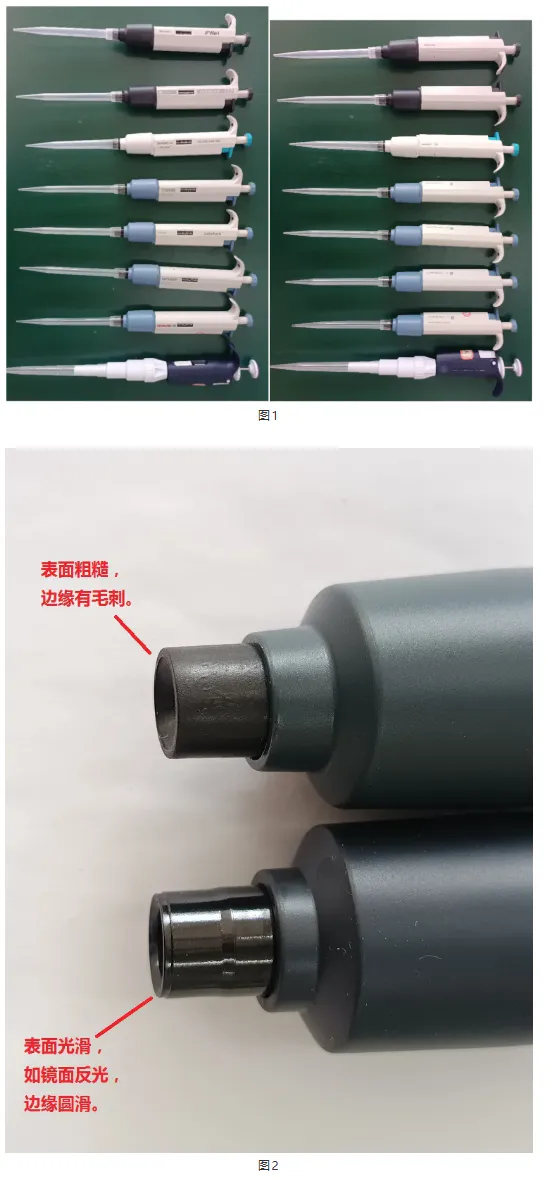 |
The seven domestic pipettes are shown in Figure 1. Their appearance and dimensions are nearly identical, with differences limited to the printed logos, color schemes, and minor details. It is suspected they may originate from the same OEM with different branding. Craftsmanship is generally consistent, with only slight differences compared to the imported brand. Only the “Fenyi Sihai” brand performed slightly worse, specifically regarding the tip cone (where the tip is attached), which was not smooth and exhibited surface roughness and burrs (Figure 2). This results in less smooth tip mounting and poses a risk of poor sealing. Other brands featured very smooth, mirror-like tip cones, allowing for smooth attachment and ejection.
(2) Tactile Feel (Hand-feel)
Evaluation was based on grip, pressing force, and rebound.
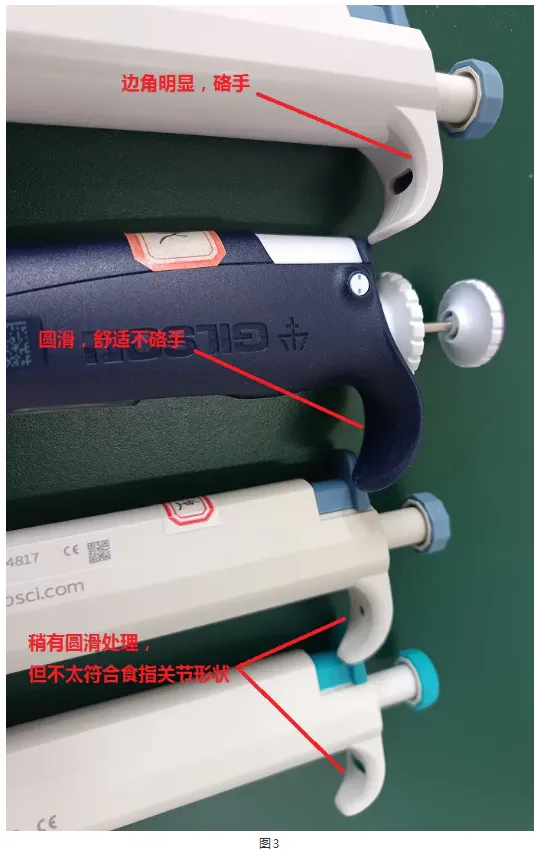
- Grip: Due to the nearly identical shapes, the grip feel is similar across the domestic brands. The only difference lies in the finger hook (where the index finger rests), as shown in Figure 3. The Gilson design is highly ergonomic; the surface is perfectly smooth and contours to the index finger joint, preventing pressure points during use. Domestic models lag significantly here; although they feature rounded edges to varying degrees, they do not fit the finger shape as well, leading to a noticeable “digging” sensation that can cause pain during prolonged use.
- Pressing Force: Ideally, the force should be moderate, with a distinct difference between the first and second stops (blow-out). The Gilson excels here, requiring minimal effort and reducing hand fatigue. Among domestic brands, only BKMAM performed well, approaching the feel of the imported model. Other brands had suboptimal spring tension—the first stop was too stiff (requiring excessive force), while the second stop was too weak, making the intermediate stop point indistinct.
- Rebound: The piston movement should be smooth with moderate return force and speed. BKMAM provided the best experience, feeling even smoother than the imported model. The other five domestic brands suffered from pistons that were too tight or had insufficient return force. Insufficient rebound force not only affects tactile feel but also impacts accuracy and durability (discussed later). Conversely, the Fenyi Sihai model had a spring that was too strong combined with a piston that was too loose, causing a violent rebound that could lead to liquid surging into the internal shaft of the pipette.
Table 1: Summary of Sensory Evaluation
| Brand | Craftsmanship | Grip | Pressing | Rebound |
| Gilson (France) | ★★★★★ | ★★★★★ | ★★★★★ | ★★★★ |
| DLAB (Beijing) | ★★★★ | ★★★ | ★★★ | ★★★ |
| BKMAM | ★★★★ | ★★★ | ★★★★ | ★★★★★ |
| JOANLAB | ★★★★ | ★★ | ★★★ | ★★★ |
| LICHEN | ★★★★ | ★★ | ★★★ | ★★★ |
| LABSHARK | ★★★★ | ★★ | ★★★ | ★★★ |
| ONiLAB | ★★★★ | ★★ | ★★★ | ★★★ |
| Fenyi Sihai | ★★★ | ★★ | ★★ |
 |
- Accuracy Evaluation
4.1 Methodology
Volume accuracy was determined via the Gravimetric Method. A 3-decimal place balance 0.001 precision) was used with deionized water as the working medium. Weighing was conducted at room temperature, and the actual volume was calculated based on the density of pure water 0.9972 at room temperature).
Prior to testing, the full-scale volume was calibrated to within 5.00±0.02mL. The accuracy tests included:
- a. Linearity: Measured at three points: Full scale (5ml), half scale(2.5ml), and 10% scale (0.55ml).
- b. Repeatability: 5 replicates per volume setting to calculate the Standard Deviation (SD).
- c. Adjustment Reproducibility: After completing a test set, the dial was moved to other volumes and then reset to the target volume after an interval. Three sets were measured to calculate the SD of the mean values between sets. (This is a non-standard metric we call “Adjustment Reproducibility”).
Technical Notes:
- The scale interval for domestic 5mL pipettes is 0.05ml The balance precision 0.01g verification, 0.002g repeatability error is significantly higher than the pipette’s precision, meeting the requirements.
- The apparent density of water at 20C is 0.9972/mL (buoyancy corrected). Within the standard working temperature range 10C to 30C, the density varies by only +0.1%~-0.2%, which is negligible compared to the pipette’s accuracy class.
- The plastic material has a coefficient of thermal expansion of approx. 50~100ppm/℃. Even at 100ppm/℃, the volume expansion is roughly 0.03%/℃, which is negligible.
4.2 Evaluation Results
Table 2 Gilson result:
| Group 1 | Group 2 | Group 3 | |||||
| 5mL | 5-1 | 5.001 | 5-1 | 4.994 | 5-1 | 4.995 | Systematic error:-0.002mL
Pipetting repeatability:±0.004mL Adjustment reproducibility:±0.003mL |
| 5-2 | 4.991 | 5-2 | 4.995 | 5-2 | 4.997 | ||
| 5-3 | 4.994 | 5-3 | 4.999 | 5-3 | 5.002 | ||
| 5-4 | 4.995 | 5-4 | 5.006 | 5-4 | 5.001 | ||
| 5-5 | 4.993 | 5-5 | 5.003 | 5-5 | 4.999 | ||
| Average | 4.9948 | Average | 4.9994 | Average | 4.9988 | ||
| Standard deviation | 0.0038 | Standard deviation | 0.0051 | Standard deviation | 0.0029 | ||
| 2.5mL | 2.5-1 | 2.488 | 2.5-1 | 2.492 | 2.5-1 | 2.498 | Systematic error:-0.003mL
Pipetting repeatability:±0.004mL Adjustment reproducibility:±0.003mL |
| 2.5-2 | 2.493 | 2.5-2 | 2.502 | 2.5-2 | 2.497 | ||
| 2.5-3 | 2.496 | 2.5-3 | 2.500 | 2.5-3 | 2.493 | ||
| 2.5-4 | 2.497 | 2.5-4 | 2.499 | 2.5-4 | 2.501 | ||
| 2.5-5 | 2.493 | 2.5-5 | 2.499 | 2.5-5 | 2.500 | ||
| Average | 2.4934 | Average | 2.4984 | Average | 2.4978 | ||
| Standard deviation | 0.0035 | Standard deviation | 0.0038 | Standard deviation | 0.0031 | ||
| 0.5mL
|
0.5-1 | 0.500 | 0.5-1 | 0.509 | 0.5-1 | 0.511 | Systematic error:+0.010mL
Pipetting repeatability:±0.002mL Adjustment reproducibility:±0.003mL
|
| 0.5-2 | 0.507 | 0.5-2 | 0.509 | 0.5-2 | 0.511 | ||
| 0.5-3 | 0.505 | 0.5-3 | 0.512 | 0.5-3 | 0.512 | ||
| 0.5-4 | 0.508 | 0.5-4 | 0.513 | 0.5-4 | 0.509 | ||
| 0.5-5 | 0.508 | 0.5-5 | 0.512 | 0.5-5 | 0.513 | ||
| Average | 0.5060 | Average | 0.5114 | Average | 0.5116 | ||
| Standard deviation | 0.0034 | Standard deviation | 0.0019 | Standard deviation | 0.0015 | ||
Table 3 DLAB result:
| Group 1 | Group 2 | Group 3 | |||||
| 5mL | 5-1 | 5.000 | 5-1 | 5.009 | 5-1 | 5.010 | Systematic error:+0.004mL
Pipetting repeatability:±0.004mL Adjustment reproducibility:±0.009mL |
| 5-2 | 4.990 | 5-2 | 5.009 | 5-2 | 5.016 | ||
| 5-3 | 4.990 | 5-3 | 5.000 | 5-3 | 5.010 | ||
| 5-4 | 4.989 | 5-4 | 5.007 | 5-4 | 5.014 | ||
| 5-5 | 5.001 | 5-5 | 5.003 | 5-5 | 5.012 | ||
| Average | 4.9940 | Average | 5.0056 | Average | 5.0124 | ||
| Standard deviation | 0.0060 | Standard deviation | 0.0040 | Standard deviation | 0.0026 | ||
| 2.5mL | 2.5-1 | 2.478 | 2.5-1 | 2.490 | 2.5-1 | 2.500 | Systematic error:-0.008mL
Pipetting repeatability:±0.004mL Adjustment reproducibility:±0.011mL |
| 2.5-2 | 2.477 | 2.5-2 | 2.503 | 2.5-2 | 2.499 | ||
| 2.5-3 | 2.479 | 2.5-3 | 2.494 | 2.5-3 | 2.504 | ||
| 2.5-4 | 2.485 | 2.5-4 | 2.492 | 2.5-4 | 2.499 | ||
| 2.5-5 | 2.481 | 2.5-5 | 2.491 | 2.5-5 | 2.504 | ||
| Average | 2.4799 | Average | 2.4940 | Average | 2.5012 | ||
| Standard deviation | 0.0032 | Standard deviation | 0.0053 | Standard deviation | 0.0026 | ||
| 0.5mL | 0.5-1 | 0.503 | 0.5-1 | 0.504 | 0.5-1 | 0.502 | Systematic error:+0.004mL
Pipetting repeatability:±0.004mL Adjustment reproducibility:±0.002mL |
| 0.5-2 | 0.499 | 0.5-2 | 0.499 | 0.5-2 | 0.503 | ||
| 0.5-3 | 0.513 | 0.5-3 | 0.506 | 0.5-3 | 0.504 | ||
| 0.5-4 | 0.498 | 0.5-4 | 0.505 | 0.5-4 | 0.500 | ||
| 0.5-5 | 0.512 | 0.5-5 | 0.503 | 0.5-5 | 0.501 | ||
| Average | 0.5054 | Average | 0.5038 | Average | 0.5024 | ||
| Standard deviation | 0.0071 | Standard deviation | 0.0027 | Standard deviation | 0.0016 | ||
Table 4 BKMAM Result:
| Group 1 | Group 2 | Group 3 | |||||
| 5mL | 5-1 | 5.007 | 5-1 | 5.025 | 5-1 | 5.013 | Systematic error:+0.013mL
Pipetting repeatability:±0.005mL Adjustment reproducibility:±0.012mL |
| 5-2 | 5.000 | 5-2 | 5.027 | 5-2 | 5.009 | ||
| 5-3 | 4.994 | 5-3 | 5.028 | 5-3 | 5.018 | ||
| 5-4 | 5.007 | 5-4 | 5.018 | 5-4 | 5.005 | ||
| 5-5 | 4.997 | 5-5 | 5.024 | 5-5 | 5.015 | ||
| Average | 5.0010 | Average | 5.0245 | Average | 5.0120 | ||
| Standard deviation | 0.0059 | Standard deviation | 0.0039 | Standard deviation | 0.0051 | ||
| 2.5mL | 2.5-1 | 2.471 | 2.5-1 | 2.476 | 2.5-1 | 2.476 | Systematic error:-0.029mL
Pipetting repeatability:±0.003mL Adjustment reproducibility:±0.002mL |
| 2.5-2 | 2.466 | 2.5-2 | 2.474 | 2.5-2 | 2.470 | ||
| 2.5-3 | 2.470 | 2.5-3 | 2.465 | 2.5-3 | 2.470 | ||
| 2.5-4 | 2.465 | 2.5-4 | 2.475 | 2.5-4 | 2.470 | ||
| 2.5-5 | 2.470 | 2.5-5 | 2.473 | 2.5-5 | 2.473 | ||
| Average | 2.4683 | Average | 2.4725 | Average | 2.4717 | ||
| Standard deviation | 0.0027 | Standard deviation | 0.0044 | Standard deviation | 0.0027 | ||
| 0.5mL | 0.5-1 | 0.448 | 0.5-1 | 0.452 | 0.5-1 | 0.450 | Systematic error:-0.049mL
Pipetting repeatability:±0.002mL Adjustment reproducibility:±0.000mL |
| 0.5-2 | 0.449 | 0.5-2 | 0.450 | 0.5-2 | 0.451 | ||
| 0.5-3 | 0.454 | 0.5-3 | 0.451 | 0.5-3 | 0.453 | ||
| 0.5-4 | 0.453 | 0.5-4 | 0.450 | 0.5-4 | 0.452 | ||
| 0.5-5 | 0.453 | 0.5-5 | 0.452 | 0.5-5 | 0.450 | ||
| Average | 0.4517 | Average | 0.4513 | Average | 0.4515 | ||
| Standard deviation | 0.0027 | Standard deviation | 0.0010 | Standard deviation | 0.0013 | ||
Table 5 JOANLAB Result:
| Group 1 | Group 2 | Group 3 | |||||
| 5mL | 5-1 | 5.005 | 5-1 | 5.019 | 5-1 | 5.007 | Systematic error:+0.008mL
Pipetting repeatability:±0.004mL Adjustment reproducibility:±0.010mL |
| 5-2 | 5.007 | 5-2 | 5.021 | 5-2 | 5.000 | ||
| 5-3 | 5.011 | 5-3 | 5.023 | 5-3 | 4.994 | ||
| 5-4 | 5.002 | 5-4 | 5.020 | 5-4 | 5.000 | ||
| 5-5 | 5.006 | 5-5 | 5.015 | 5-5 | 4.995 | ||
| Average | 5.0062 | Average | 5.0197 | Average | 4.9992 | ||
| Standard deviation | 0.0033 | Standard deviation | 0.0030 | Standard deviation | 0.0052 | ||
| 2.5mL | 2.5-1 | 2.499 | 2.5-1 | 2.511 | 2.5-1 | 2.495 | Systematic error: 0.000mL
Pipetting repeatability:±0.002mL Adjustment reproducibility:±0.007mL |
| 2.5-2 | 2.497 | 2.5-2 | 2.507 | 2.5-2 | 2.491 | ||
| 2.5-3 | 2.500 | 2.5-3 | 2.506 | 2.5-3 | 2.494 | ||
| 2.5-4 | 2.495 | 2.5-4 | 2.508 | 2.5-4 | 2.494 | ||
| 2.5-5 | 2.499 | 2.5-5 | 2.506 | 2.5-5 | 2.494 | ||
| Average | 2.4980 | Average | 2.5076 | Average | 2.4936 | ||
| Standard deviation | 0.0020 | Standard deviation | 0.0021 | Standard deviation | 0.0015 | ||
| 0.5mL | 0.5-1 | 0.502 | 0.5-1 | 0.504 | 0.5-1 | 0.500 | Systematic error:+0.002mL
Pipetting repeatability:±0.001mL Adjustment reproducibility:±0.002mL |
| 0.5-2 | 0.501 | 0.5-2 | 0.502 | 0.5-2 | 0.500 | ||
| 0.5-3 | 0.502 | 0.5-3 | 0.504 | 0.5-3 | 0.499 | ||
| 0.5-4 | 0.502 | 0.5-4 | 0.502 | 0.5-4 | 0.501 | ||
| 0.5-5 | 0.501 | 0.5-5 | 0.501 | 0.5-5 | 0.497 | ||
| Average | 0.5020 | Average | 0.5030 | Average | 0.4998 | ||
| Standard deviation | 0.0034 | Standard deviation | 0.0019 | Standard deviation | 0.0015 | ||
Table 6 LICHEN Result:
| Group 1 | Group 2 | Group 3 | |||||
| 5mL | 5-1 | 4.998 | 5-1 | 5.016 | 5-1 | 5.000 | Systematic error:-0.002mL
Pipetting repeatability:±0.006mL Adjustment reproducibility:±0.012mL |
| 5-2 | 4.989 | 5-2 | 5.013 | 5-2 | 4.983 | ||
| 5-3 | 4.993 | 5-3 | 5.011 | 5-3 | 4.978 | ||
| 5-4 | 4.990 | 5-4 | 5.004 | 5-4 | 4.989 | ||
| 5-5 | 4.998 | 5-5 | 5.016 | 5-5 | 4.996 | ||
| Average | 4.9936 | Average | 5.0120 | Average | 4.9892 | ||
| Standard deviation | 0.0043 | Standard deviation | 0.0050 | Standard deviation | 0.0091 | ||
| 2.5mL | 2.5-1 | 2.491 | 2.5-1 | 2.504 | 2.5-1 | 2.479 | Systematic error:-0.007mL
Pipetting repeatability:±0.004mL Adjustment reproducibility:±0.013mL |
| 2.5-2 | 2.491 | 2.5-2 | 2.499 | 2.5-2 | 2.477 | ||
| 2.5-3 | 2.491 | 2.5-3 | 2.512 | 2.5-3 | 2.480 | ||
| 2.5-4 | 2.496 | 2.5-4 | 2.507 | 2.5-4 | 2.480 | ||
| 2.5-5 | 2.502 | 2.5-5 | 2.508 | 2.5-5 | 2.481 | ||
| Average | 2.4942 | Average | 2.5060 | Average | 2.4793 | ||
| Standard deviation | 0.0049 | Standard deviation | 0.0049 | Standard deviation | 0.0015 | ||
| 0.5mL | 0.5-1 | 0.504 | 0.5-1 | 0.513 | 0.5-1 | 0.494 | Systematic error:+0.008mL
Pipetting repeatability:±0.004mL Adjustment reproducibility:±0.006mL |
| 0.5-2 | 0.510 | 0.5-2 | 0.516 | 0.5-2 | 0.502 | ||
| 0.5-3 | 0.507 | 0.5-3 | 0.509 | 0.5-3 | 0.505 | ||
| 0.5-4 | 0.516 | 0.5-4 | 0.513 | 0.5-4 | 0.500 | ||
| 0.5-5 | 0.503 | 0.5-5 | 0.511 | 0.5-5 | 0.506 | ||
| Average | 0.5084 | Average | 0.5128 | Average | 0.5018 | ||
| Standard deviation | 0.0053 | Standard deviation | 0.0026 | Standard deviation | 0.0048 | ||
Table 7 LABSHARK Result:
| Group 1 | Group 2 | Group 3 | |||||
| 5mL | 5-1 | 4.993 | 5-1 | 5.010 | 5-1 | 4.999 | Systematic error: 0.000mL
Pipetting repeatability:±0.006mL Adjustment reproducibility:±0.011mL |
| 5-2 | 4.987 | 5-2 | 4.996 | 5-2 | 5.013 | ||
| 5-3 | 4.986 | 5-3 | 5.009 | 5-3 | 5.015 | ||
| 5-4 | 4.994 | 5-4 | 5.001 | 5-4 | 5.009 | ||
| 5-5 | 4.983 | 5-5 | 4.996 | 5-5 | 5.010 | ||
| Average | 4.9886 | Average | 5.002 | Average | 5.0092 | ||
| Standard deviation | 0.0047 | Standard deviation | 0.0068 | Standard deviation | 0.0062 | ||
| 2.5mL | 2.5-1 | 2.504 | 2.5-1 | 2.505 | 2.5-1 | 2.477 | Systematic error:-0.007mL
Pipetting repeatability:±0.004mL Adjustment reproducibility:±0.016mL |
| 2.5-2 | 2.500 | 2.5-2 | 2.496 | 2.5-2 | 2.473 | ||
| 2.5-3 | 2.500 | 2.5-3 | 2.501 | 2.5-3 | 2.473 | ||
| 2.5-4 | 2.510 | 2.5-4 | 2.503 | 2.5-4 | 2.473 | ||
| 2.5-5 | 2.496 | 2.5-5 | 2.503 | 2.5-5 | 2.475 | ||
| Average | 2.5020 | Average | 2.5016 | Average | 2.4741 | ||
| Standard deviation | 0.0053 | Standard deviation | 0.0034 | Standard deviation | 0.0018 | ||
| 0.5mL | 0.5-1 | 0.508 | 0.5-1 | 0.509 | 0.5-1 | 0.494 | Systematic error:+0.006mL
Pipetting repeatability:±0.002mL Adjustment reproducibility:±0.006mL |
| 0.5-2 | 0.509 | 0.5-2 | 0.508 | 0.5-2 | 0.502 | ||
| 0.5-3 | 0.507 | 0.5-3 | 0.512 | 0.5-3 | 0.498 | ||
| 0.5-4 | 0.508 | 0.5-4 | 0.508 | 0.5-4 | 0.500 | ||
| 0.5-5 | 0.509 | 0.5-5 | 0.507 | 0.5-5 | 0.499 | ||
| Average | 0.5086 | Average | 0.5092 | Average | 0.4990 | ||
| Standard deviation | 0.0008 | Standard deviation | 0.0019 | Standard deviation | 0.0030 | ||
Table 8 ONiLAB Result:
| Group 1 | Group 2 | Group 3 | |||||
| 5mL | 5-1 | 5.006 | 5-1 | 5.027 | 5-1 | 5.005 | Systematic error:+0.012mL
Pipetting repeatability:±0.004mL Adjustment reproducibility:±0.013mL |
| 5-2 | 5.008 | 5-2 | 5.023 | 5-2 | 4.995 | ||
| 5-3 | 5.011 | 5-3 | 5.030 | 5-3 | 5.00 | ||
| 5-4 | 5.009 | 5-4 | 5.025 | 5-4 | 4.994 | ||
| 5-5 | 5.009 | 5-5 | 5.025 | 5-5 | 4.99 | ||
| Average | 5.0086 | Average | 5.0261 | Average | 5.0002 | ||
| Standard deviation | 0.0018 | Standard deviation | 0.0027 | Standard deviation | 0.0062 | ||
| 2.5mL | 2.5-1 | 2.515 | 2.5-1 | 2.524 | 2.5-1 | 2.479 | Systematic error:+0.004mL
Pipetting repeatability:±0.002mL Adjustment reproducibility:±0.023mL |
| 2.5-2 | 2.516 | 2.5-2 | 2.518 | 2.5-2 | 2.475 | ||
| 2.5-3 | 2.512 | 2.5-3 | 2.518 | 2.5-3 | 2.480 | ||
| 2.5-4 | 2.511 | 2.5-4 | 2.522 | 2.5-4 | 2.480 | ||
| 2.5-5 | 2.513 | 2.5-5 | 2.524 | 2.5-5 | 2.480 | ||
| Average | 2.5134 | Average | 2.5213 | Average | 2.4787 | ||
| Standard deviation | 0.002 | Standard deviation | 0.0030 | Standard deviation | 0.0022 | ||
| 0.5mL | 0.5-1 | 0.528 | 0.5-1 | 0.524 | 0.5-1 | 0.514 | Systematic error:+0.022mL
Pipetting repeatability:±0.002mL Adjustment reproducibility:±0.008mL |
| 0.5-2 | 0.527 | 0.5-2 | 0.525 | 0.5-2 | 0.514 | ||
| 0.5-3 | 0.526 | 0.5-3 | 0.525 | 0.5-3 | 0.512 | ||
| 0.5-4 | 0.531 | 0.5-4 | 0.526 | 0.5-4 | 0.515 | ||
| 0.5-5 | 0.524 | 0.5-5 | 0.525 | 0.5-5 | 0.51 | ||
| Average | 0.5277 | Average | 0.5255 | Average | 0.5134 | ||
| Standard deviation | 0.0026 | Standard deviation | 0.000 | Standard deviation | 0.0020 | ||
Table 9 Fenyi Sihai Result:
| Group 1 | Group 2 | Group 3 | |||||
| 5mL | 5-1 | 4.994 | 5-1 | 4.982 | 5-1 | 4.992 | Systematic error:-0.008mL
Pipetting repeatability:±0.004mL Adjustment reproducibility:±0.001mL |
| 5-2 | 4.994 | 5-2 | 4.996 | 5-2 | 4.996 | ||
| 5-3 | 4.990 | 5-3 | 4.989 | 5-3 | 4.989 | ||
| 5-4 | 4.995 | 5-4 | 4.994 | 5-4 | 4.991 | ||
| 5-5 | 4.990 | 5-5 | 4.996 | 5-5 | 4.988 | ||
| Average | 4.9926 | Average | 4.9914 | Average | 4.9912 | ||
| Standard deviation | 0.0024 | Standard deviation | 0.0060 | Standard deviation | 0.0031 | ||
| 2.5mL | 2.5-1 | 2.503 | 2.5-1 | 2.499 | 2.5-1 | 2.496 | Systematic error:-0.001mL
Pipetting repeatability:±0.002mL Adjustment reproducibility:±0.003mL |
| 2.5-2 | 2.504 | 2.5-2 | 2.503 | 2.5-2 | 2.495 | ||
| 2.5-3 | 2.498 | 2.5-3 | 2.502 | 2.5-3 | 2.495 | ||
| 2.5-4 | 2.502 | 2.5-4 | 2.499 | 2.5-4 | 2.496 | ||
| 2.5-5 | 2.499 | 2.5-5 | 2.500 | 2.5-5 | 2.497 | ||
| Average | 2.5012 | Average | 2.5006 | Average | 2.4958 | ||
| Standard deviation | 0.0026 | Standard deviation | 0.0018 | Standard deviation | 0.0008 | ||
| 0.5mL | 0.5-1 | 0.506 | 0.5-1 | 0.505 | 0.5-1 | 0.503 | Systematic error:+0.003mL
Pipetting repeatability:±0.002mL Adjustment reproducibility:±0.002mL |
| 0.5-2 | 0.502 | 0.5-2 | 0.502 | 0.5-2 | 0.500 | ||
| 0.5-3 | 0.502 | 0.5-3 | 0.508 | 0.5-3 | 0.500 | ||
| 0.5-4 | 0.500 | 0.5-4 | 0.505 | 0.5-4 | 0.502 | ||
| 0.5-5 | 0.507 | 0.5-5 | 0.502 | 0.5-5 | 0.500 | ||
| Average | 0.5038 | Average | 0.5048 | Average | 0.5014 | ||
| Standard deviation | 0.0030 | Standard deviation | 0.0025 | Standard deviation | 0.0014 | ||
Table 10 Summary of Accuracy Evaluation Results
| Gilson | Dlab | BKMAM | JOANLAB | LICHEN | LABSHARK | ONiLAB | Fenyi Sihai | ||
| Full Scale(5mL) | Systematic error | -0.002mL | +0.004mL | +0.013mL | +0.008mL | -0.002mL | 0.000mL | +0.012mL | -0.008mL |
| Pipetting repeatability | ±0.004mL | ±0.004mL | ±0.005mL | ±0.004mL | ±0.006mL | ±0.006mL | 0.004mL | ±0.004mL | |
| Adjustment reproducibility | ±0.003mL | ±0.009mL | ±0.012mL | ±0.010mL | ±0.012mL | ±0.011mL | ±0.013mL | ±0.001mL | |
| 50% Scale
(2.5mL) |
Systematic error | -0.003mL | -0.008mL | -0.029mL | 0.000mL | -0.007mL | -0.007mL | +0.004mL | -0.001mL |
| Pipetting repeatability | ±0.004mL | ±0.004mL | ±0.003mL | ±0.002mL | ±0.004mL | ±0.004mL | ±0.002mL | ±0.002mL | |
| Adjustment reproducibility | ±0.003mL | ±0.011mL | ±0.002mL | ±0.007mL | ±0.013mL | ±0.016mL | ±0.023mL | ±0.003mL | |
| 10% Scale
(0.5mL) |
Systematic error | +0.010mL | +0.004mL | -0.049mL | +0.002mL | +0.008mL | +0.006mL | +0.022mL | +0.003mL |
| Pipetting repeatability | ±0.002mL | ±0.004mL | ±0.002mL | ±0.001mL | ±0.004mL | ±0.002mL | ±0.002mL | ±0.002mL | |
| Adjustment reproducibility | ±0.003mL | ±0.002mL | ±0.000mL | ±0.002mL | ±0.006mL | ±0.006mL | ±0.008mL | ±0.002mL | |
| Overall Evaluation (RMS) | Systematic error | 0.006 | 0.006 | 0.034 | 0.005 | 0.006 | 0.005 | 0.015 | 0.005 |
| Pipetting repeatability | 0.003 | 0.004 | 0.004 | 0.003 | 0.005 | 0.004 | 0.003 | 0.003 | |
| Adjustment reproducibility | 0.003 | 0.008 | 0.007 | 0.007 | 0.011 | 0.012 | 0.016 | 0.002 |
4.3 Discussion
Overall, the accuracy of domestic pipettes is impressive. We should discard the prejudice that domestic instruments equate to “low quality.” In fact, they can be excellent cost-effective alternatives.
- Repeatability: Domestic pipettes are nearly on par with imported ones.
- Adjustment Reproducibility: Slightly inferior to imported models but within acceptable limits.
- Linearity: Performance is inconsistent; some are close to imported standards, while others show a significant gap.
(1) Systematic Error and Linearity
Since most pipettes only allow for single-point calibration (usually at full scale), errors at other volumes cannot be proportionally corrected if linearity is poor. Most domestic pipettes met the error requirements across the full range, but a few showed large errors at lower volumes. For instance, the BKMAM pipette had a systematic error near $-0.05 \text{ mL}$ at the $0.5 \text{ mL}$ setting, reaching the scale interval value. Ideally, the Maximum Permissible Error (MPE) should not exceed half of the scale interval. We recommend manufacturers introduce two-point calibration to improve linearity.
(2) Adjustment Reproducibility
Domestic pipettes use digital dials, which can lead to the misconception that the displayed number is the absolute volume. However, mechanical threads always have clearances (backlash). The test data shows that domestic digital dials are less precise than the imported pointer-style dials, indicating that the precision of domestic adjustment threads needs improvement.
(3) Piston Rebound and Durability
When the piston is too tight and spring tension is insufficient, the piston may fail to return fully, leading to under-pipetting. Under high-intensity use, metal fatigue in the spring can cause temporary failure. As shown in Figure 4, performing more than 10 continuous aspirations without pause revealed a gradual decrease in actual volume, with the variance exceeding $3\times$ the normal SD. This phenomenon was observed across five domestic brands. Interestingly, the BKMAM (due to smooth piston movement) and Fenyi Sihai (due to high spring force) did not exhibit this issue.
- Conclusion
- To Manufacturers: Pipettes are small but vital. Domestic brands are cost-effective, but minor quality gaps remain. Manufacturers should focus on “high-quality development” and precision rather than just low-price competition.
- General Recommendation: Domestic pipettes offer great value. While minor deficiencies exist, they provide satisfactory results if used and calibrated correctly. Given potential issues at the extreme ends of the range, we suggest using the middle range of the volume scale and ensuring regular calibration.
- Closing Thought: The conclusion regarding spring fatigue and decreasing volume is somewhat speculative and requires more data. An alternative theory suggests that heat transfer from the palm during prolonged holding affects the volume. However, this does not explain why only certain brands or specific (full-scale) volumes are affected, especially since the piston is located at the bottom, relatively far from the handgrip.
It’s one of the most essential tools in any lab, but do you know all its types and functions? Dive into our ultimate guide on pipettes-What is a pipette.