
Should I choose which type vacuum pump for my Rotary Evaporator?
Conclusion: For a modern laboratory, the chemical-resistant diaphragm pump is the overwhelmingly recommended choice for rotary evaporators. Rotary vane pumps are specialized for deep vacuum applications, and water pumps are now largely considered outdated for environmental and performance reasons.
Here is a summary of the choices:
1. Corrosion-resistant diaphragm vacuum pump (Recommended Choice)
|
|

Best For: Nearly all rotary evaporation applications.
How it Works: An oil-free mechanism uses a flexible diaphragm to pump vapor. Models designed for chemistry are made with PTFE and other fluoropolymers on all wetted surfaces.
Pros:
Excellent Chemical Resistance: Not damaged by solvent vapors.
No Contamination: Oil-free design means no risk of oil back-streaming into your sample.
Environmentally Friendly: No oil waste and no water consumption.
Low Maintenance: No regular oil changes are required.
Stable & Controllable Vacuum: Provides consistent and adjustable vacuum levels, ideal for preventing bumping and optimizing evaporation for different solvents.
Cons:
Higher initial purchase price compared to a water pump.
2. Rotary Vane Pump (Oil Pump)
|
|

Best For: Applications requiring a very deep vacuum (<1 mbar), such as high-boiling-point solvents (DMSO, DMF), freeze dryers, or molecular distillation. It’s generally overkill for standard rotary evaporation.
How it Works: Uses oil-sealed rotating vanes to create a very deep vacuum.
Pros:
Deepest Vacuum: Can achieve much lower pressures than diaphragm or water pumps.
Cons:
Contamination Risk: Oil vapor can get into the sample.
High Maintenance: Requires frequent oil changes, especially when exposed to solvent vapors which contaminate the oil.
Chemical Damage: Corrosive vapors will damage the pump mechanism if not properly protected.
Requires a Cold Trap: It is essential to use a liquid nitrogen or dry ice cold trap before the pump to protect it from solvent vapors.
3. Water Aspirator Pump (Outdated Choice)
|
|
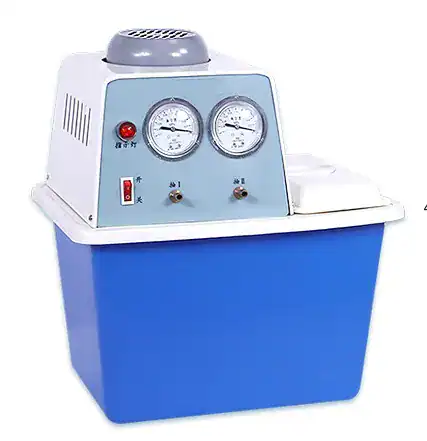
Best For: Educational settings or labs with extremely limited budgets where environmental regulations are not a concern. It is not recommended for modern research or production labs.
How it Works: Uses the Venturi effect from running tap water to create a vacuum.
Pros:
Very Low Initial Cost.
Handles solvent vapors well since they dissolve in the wastewater stream.
Cons:
Environmental Issues: Wastes enormous amounts of water (up to 50,000 gallons per year per pump) and pollutes it with solvent vapors, which is illegal in many regions.
Inconsistent Vacuum: The vacuum level depends on water pressure and temperature, which can fluctuate throughout the day.
Poor Performance in Summer: As water temperature rises, the vacuum level gets significantly worse.
Risk of Water Suck-Back: A drop in water pressure can cause water to be sucked back into the evaporator, ruining the sample.
2. Vapor Handling Capability:
Original Point: “Water pumps handle vapors well by dissolving them, whereas diaphragm pumps need extra cold traps.”
Modern Analysis: This is partially incorrect. A key advantage of a modern chemical-resistant diaphragm pump is that it’s designed to handle chemical vapors without being damaged. It does not require a cold trap for pump protection with most common solvents (unlike a rotary vane pump). While an outlet condenser is recommended for solvent recovery, the pump itself is robust.
3. Vacuum Level Suitability:
Original Point: “Water pumps provide a suitable vacuum (10-50 mbar) for most solvents. A diaphragm pump’s deeper vacuum can cause violent boiling (bumping).”
Modern Analysis: This is a flawed argument. The issue is not the pump’s ultimate vacuum, but the lack of control. A good diaphragm pump system is paired with a vacuum controller that allows the user to set and maintain the precise pressure needed. This provides far more control than a water pump and is the best way to prevent bumping, regardless of the solvent.
4. Corrosion Resistance & Durability:
Original Point: “Water pumps are simple and corrosion-resistant. Diaphragm pumps have PTFE parts that can age with vapor exposure.”
Modern Analysis: This is misleading. The PTFE and fluoropolymer components in a quality chemistry-grade diaphragm pump are exceptionally resistant to chemical attack and are designed for a long service life precisely in these conditions. They are far more durable against aggressive organic vapors than the simple components of a water aspirator.
5. Application Differences :
Original Point: “Diaphragm pumps are for high-vacuum, fine operations. Water pumps are better for high-throughput solvent removal in rotovaps.”
Modern Analysis: This reverses the modern reality. For high-throughput and reproducible evaporation, a controlled diaphragm pump is superior because it provides stable, optimized conditions. Water pumps are imprecise and inefficient. Diaphragm pumps are the standard for rotovaps, while deep vacuum pumps (like rotary vane pumps) are for more specialized fine operations.
Exception:
Original Point: “For high-boiling-point solvents, a diaphragm pump can be used, but a cold trap is needed to protect it.”
Modern Analysis: For high-boiling-point solvents (DMF, DMSO), a deeper vacuum is needed. A high-performance, multi-stage diaphragm pump is often sufficient. If an even deeper vacuum is required, a rotary vane pump is the correct tool. A cold trap is not typically needed to protect a diaphragm pump itself.
Based on the above analysis, equipping your rotary evaporator with a corrosion-resistant diaphragm vacuum pump is the optimal choice.
If you would like to learn more about rotary evaporators, please visit our page: How Does a Rotary Evaporator Work?
This guide is maintained by HINOTEK’s core technical team, comprised of senior engineers and application scientists with over two decades of hands-on experience in fields such as microscopy, centrifugation, and spectrophotometry. We are committed to ensuring that every piece of information in this guide—from instrument principles and technical specifications to laboratory procurement advice—maintains the highest level of accuracy and timeliness.
This content is regularly reviewed and updated to reflect the latest industry standards and technological advancements. We value feedback from the global scientific community. Should you have any questions or suggestions, or wish to discuss any technical details, please do not hesitate to contact our expert team at [email protected].