
 |
At HINOTEK, we often receive technical inquiries from researchers and distributors regarding microscope configurations. One of the most common challenges occurs when users transition to digital imaging: “I connected my CCD camera to the trinocular port, but there is no image.”
The answer usually lies in the design of the Microscope Viewing Head (also known as the observation tube). Understanding how these components manage light is crucial for both visual comfort and successful photomicrography.
Part 01: The Anatomy of an Observation Tube
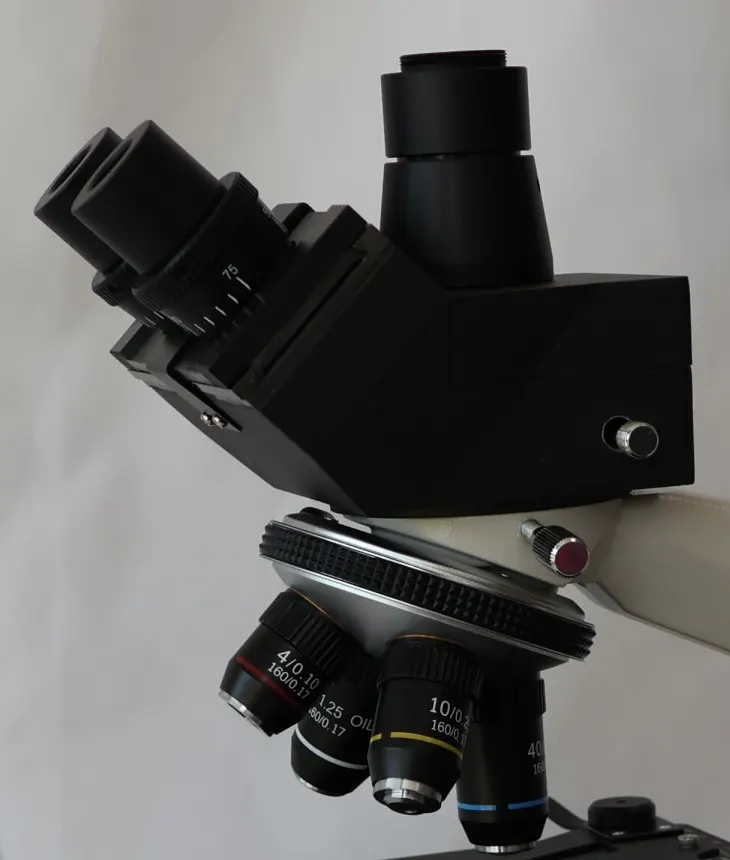 |
The viewing head is the bridge between the objective lenses and the user’s eyes (or camera). Its design determines the ergonomics and functional scalability of the microscope.
-
The Microscope Tube: This housing directs light from the objectives to the eyepieces. Modern designs offer high flexibility for adjusting the stage and revolving nosepiece.
-
Mechanical Tube Length: In most standard biological microscopes (including those from HINOTEK), the distance from the eyepiece flange to the objective shoulder is fixed at 160mm.
-
Eyepiece Mounting: Heads can be straight or, more commonly, inclined at 30° or 45° for ergonomic viewing.
-
Adjustment Mechanisms: Professional binocular heads include Interpupillary Distance Adjustment (to match the distance between your eyes) and a Diopter Adjustment on at least one eyepiece tube to compensate for vision differences between the left and right eye.
Part 02: Choosing the Right Type: Monocular, Binocular, or Trinocular?
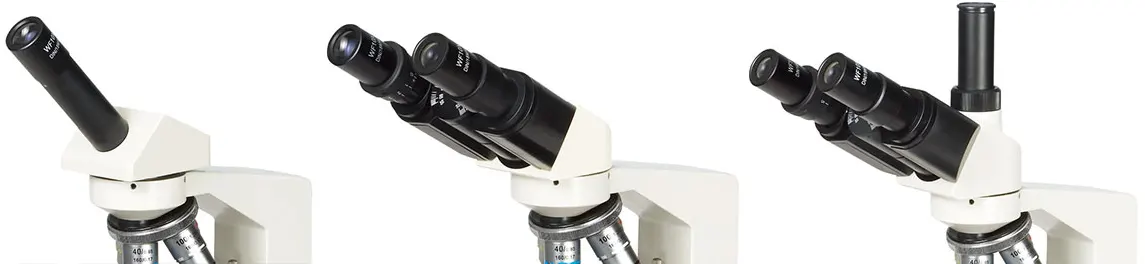 |
1. Monocular Head (Single Eyepiece)
-
Structure: Features a single eyepiece for one-eye observation.
-
Pros: Compact, portable, and cost-effective.
-
Best For: Basic education, student labs, and simple field inspections where high-resolution 3D depth is not required.
-
Limitation: Prolonged use can cause eye fatigue; not suitable for professional digital imaging.
2. Binocular Head (Dual Eyepieces)
-
Structure: Uses a beam splitter prism to divide the light into two paths for comfortable two-eye viewing.
-
Pros: Significantly reduces eye strain and provides a more immersive, “natural” view.
-
Sub-types: * Binocular Biological Head: Single objective path split into two.
-
Stereo Microscope Head: Dual objective paths for true 3D/depth perception.
-
-
Best For: Routine clinical work, material inspection, and long hours in the lab.
3. Trinocular Head (The Professional Choice)
-
Structure: Features two eyepieces for observation plus a third vertical port for a CCD/CMOS camera.
-
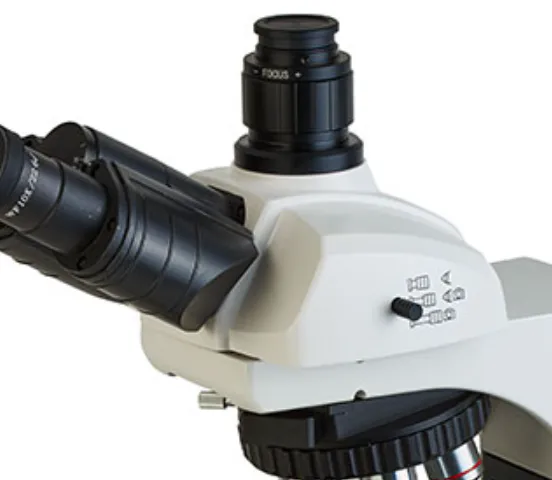
The “Secret” – Light Path Switching: Most high-end trinocular microscopes utilize a pull-rod or a switch to direct light.
-
Position A (100:0): 100% of light to eyepieces (visual mode).
-
Position B (0:100 or 50:50): Light is diverted to the camera port.
Technical Note: If your CCD shows a black screen, ensure the light path selector is pulled out or engaged to allow light to reach the camera sensor!
-
Part 03: Comparison Table for Quick Selection
| Feature | Monocular | Binocular | Trinocular |
| Observation | Single eye | Both eyes | Both eyes + Camera |
| Ergonomics | Low | High | High |
| Digital Imaging | Not recommended | Requires eyepiece adapter | Dedicated Camera Port |
| Typical User | Students / Hobbyists | Lab Technicians | Researchers / QA Engineers |
Frequently Asked Questions (FAQ)
Q: Does a binocular head provide a clearer image than a monocular one? A: Clarity depends on the quality of the objectives. However, a binocular head provides better visual comfort and perceived depth, which helps in identifying fine details during long sessions.
Q: Why is my microscope camera image dark or non-existent? A: Check the beam splitter lever on the side of the trinocular head. Many microscopes require you to manually “push” or “pull” a rod to send light to the camera port instead of the eyepieces.
Q: Can I adjust the eyepieces if I wear glasses? A: Yes. Use the interpupillary adjustment to align the exit pupils and the diopter ring to focus the image perfectly for your eyesight.
Conclusion
Selecting the correct viewing head is the first step toward a productive laboratory setup. For high-level research and documentation, a Trinocular head is the industry standard, offering the versatility needed for modern digital microscopy.
Looking for the right microscope for your laboratory or distribution business? Explore the full range of HINOTEK Optical Instruments and find the perfect match for your technical requirements.
To understand the fundamental principles common to all types of biological Microscope, be sure to read our main article: What Is A Biological Microscope.