
 |
A surface tensiometer (Discover HINOTEK Surface Tensiometerdesigned for your research) is a high-precision laboratory instrument designed to measure the tension at the surface of a liquid or at the interface between two immiscible liquids. This measurement, known as surface tension or interfacial tension, is a fundamental physical property that dictates how liquids behave.
This guide explains the scientific principles behind surface tension, the components of a modern automatic tensiometer, the two primary measurement methods, and the critical applications for this instrument across research and industry.
The Science of Surface Tension: Why Liquids Have a “Skin”
 |
 |
 |
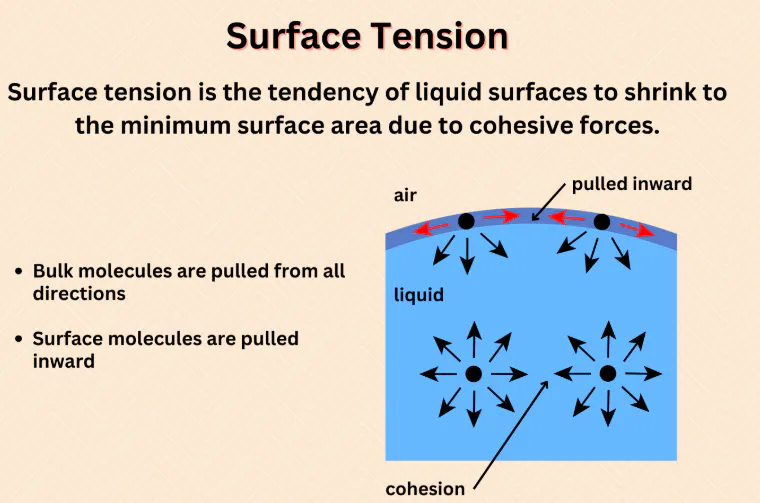
The phenomena of surface tension are visible in everyday life, from morning dew on a leaf to the curved surface of water in a glass. To understand what a tensiometer measures, we must first look at the forces acting on molecules within a liquid.This property is caused by intermolecular cohesive forces, also known as van der Waals forces.
- Inside the Liquid: A molecule deep within the bulk of a liquid is surrounded by other molecules. It is pulled equally in all directions by these cohesive forces, resulting in a balanced, low-energy state.
- At the Surface: A molecule at the surface (the interface between the liquid and the air) is in a different situation. It is pulled by its neighbors below and to the sides, but there are no corresponding liquid molecules above it to provide an upward pull.
This creates an unbalanced net inward force. This force pulls the surface molecules together, causing the liquid to contract to the minimum possible surface area. This tension creates a “skin-like” effect on the surface, which is strong enough to resist external forces and is the reason liquid droplets naturally form a sphere—the shape with the smallest surface-area-to-volume ratio.This tension can be understood in two equivalent ways :
- As a Force: It is the force (measured in millinewtons, mN) acting along a unit length (in meters, m) of the surface. The standard unit is mN/m.
- As an Energy: It is the work, or energy (in millijoules, mJ), required to create a new unit of surface area (in square meters, m²). The equivalent unit is mJ/m².
A surface tensiometer typically measures the force, but the result (mN/m) is numerically identical to the surface free energy (mJ/m²). This connects the mechanical measurement to the fundamental thermodynamic property of the system.
Surface Tension vs. Interfacial Tension: A Critical Distinction
 |
The terms “surface tension” and “interfacial tension” are often used interchangeably, but they have specific meanings.
- Surface Tension (ST): This term specifically refers to the tension at a liquid-gas interface. The most common example is a liquid (like water) in contact with the air.
- Interfacial Tension (IFT): This is the more general term. It refers to the tension at the boundary between any two immiscible phases. This includes liquid-liquid (e.g., oil and water) or liquid-solid (e.g., paint on a wall).
The magnitude of the IFT determines how the two phases will interact. For example, oil and water have a high IFT, meaning their molecules resist mixing and will spontaneously separate.Chemicals called surfactants (surface-active agents) work by lowering this IFT, allowing oil and water to mix and form a stable emulsion. A surface tensiometer is the primary tool used to measure these properties, which is why it is also commonly referred to as an Interfacial Tension Meter.
Inside the Instrument: The Core Components
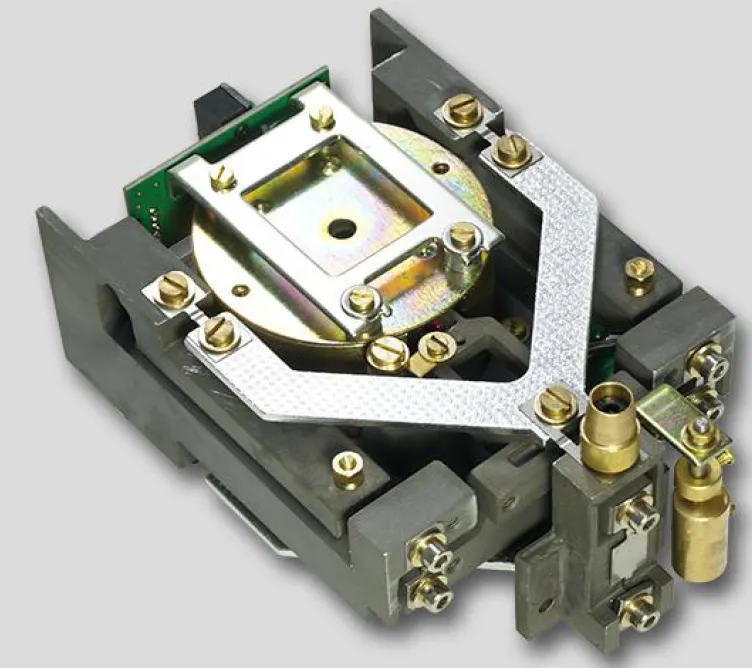
Modern automatic tensiometers, such as the BZY series, are integrated systems. While they appear simple, they are built around a few high-precision components.
 |
-
- The “Heart”: The Electromagnetic Force Sensor This is the most critical part of the instrument. It is not a simple scale but a high-precision electromagnetic force balance. It is specifically designed to measure the minuscule push or pull forces (often in the range) exerted on the measurement probe. The accuracy and repeatability of this sensor are what determine the instrument’s performance.
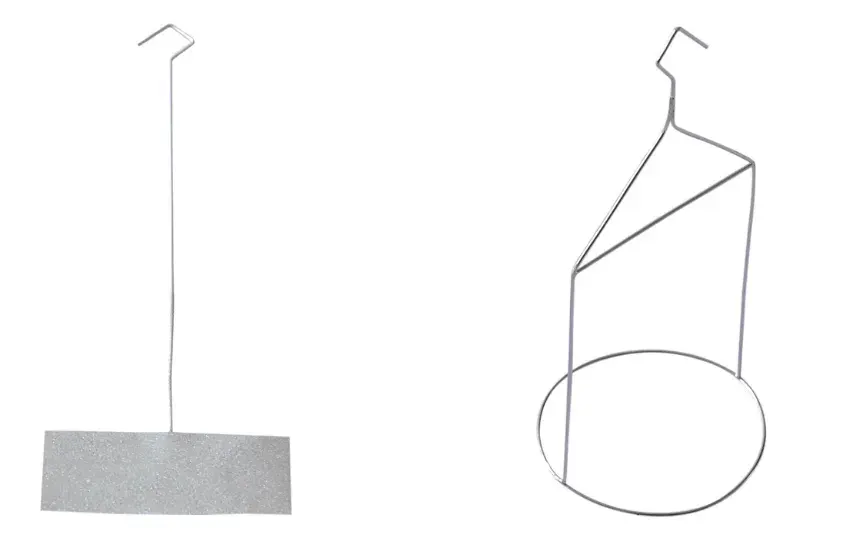 |
- The “Hands”: Measurement Probes (Platinum) These are the objects that make contact with the liquid interface. They are almost always made of platinum or a platinum-iridium alloy because platinum is chemically inert and can be easily cleaned by flame. There are two primary types:
- The Wilhelmy Plate: A thin, rectangular plate of platinum with a roughened surface to ensure complete wetting.
- The Du Nouy Ring: A precisely manufactured platinum-iridium ring with a specific wire radius and ring circumference.
- The “Body”: Sample Stage and Controls
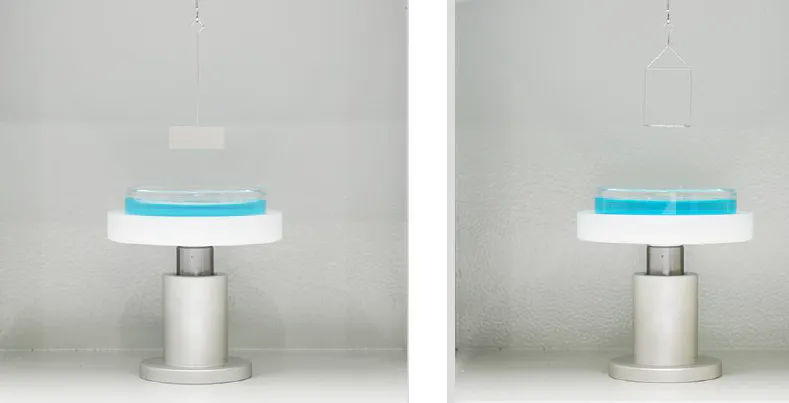
- Automatic Sample Lift Table: A motorized platform that holds the liquid sample vessel. This stage moves up or down with high precision. This automation is essential for repeatable measurements, as it controls the speed of immersion and withdrawal, removing the potential for operator error.
- Leveling System: The instrument must be perfectly horizontal for the force sensor to measure a true vertical pull. All laboratory tensiometers include a leveling bubble and adjustable knobs to ensure the instrument is perfectly level before use.
- Windshield Cover: A glass cover that encloses the measurement area and protects the sensitive probe from the environment.
- The “Brain”: Controller & Interface A built-in controller, often with a touch screen, allows the operator to select the method, input necessary parameters (like liquid densities), tare the sensor, and view the real-time measurement curve and final result.
Why Are Stability and Cleanliness So Important?
A surface tensiometer is a high-sensitivity microbalance. Treating it like a rugged piece of lab equipment will result in useless data.
The instrument manual for a tensiometer will always specify a strict operating environment: “free of dust and vibration,” and “wind should not blow directly against the instrument”. This is not optional. The windshield cover is essential because a simple air current from a ventilation system or a person walking by can exert a force on the probe, causing the reading to be unstable.Likewise, the instrument must be perfectly level. If it is tilted, the force vector being measured is not perfectly vertical, and the sensor reading will be incorrect. The 30-minute warm-up period specified for many models is also critical, as it allows the electronics in the electromagnetic force sensor to reach a stable operating temperature.
TABLE 1: Key Components of an Automatic Surface Tensiometer
| Component | Function | Why It Is Important |
| Electromagnetic Force Sensor | The high-precision balance that measures the pull/push force. | Determines the accuracy and resolution (e.g., ) of the instrument. |
| Platinum Probe (Ring or Plate) | The object that contacts the liquid interface to be measured. | The choice of probe (Ring vs. Plate) dictates the method and applications. |
| Automatic Sample Lift Table | Motorized stage to precisely move the sample vessel. | Enables automatic, repeatable measurement and removes operator error. |
| Leveling Bubble & Knobs | Ensures the instrument is perfectly horizontal. | A non-level instrument gives an incorrect force reading. |
| Windshield Cover | Protects the probe and sample from air currents. | Air drafts can cause “noise” and unstable readings. |
| Alcohol Lamp | Used to burn the platinum probe clean before every test. | Critical. Ensures no contaminants (surfactants) are on the probe. |
The Measurement Methods: Wilhelmy Plate vs. Du Nouy Ring
A tensiometer that supports both methods (like the BZY series ) provides the most flexibility, as the choice of probe is not arbitrary. It is dictated by the sample being measured.
The Wilhelmy Plate Method: The Static Equilibrium Measurement
The Wilhelmy plate method, developed in 1863, is a simple and accurate method for measuring equilibrium surface tension.
How it works:
- A clean platinum plate is suspended from the force sensor.
- The automatic sample stage moves the liquid vessel up until the liquid just touches the bottom edge of the plate.
- The liquid “wets” the plate, forming a meniscus (a curved surface) and pulling the plate downward due to surface tension.
- The plate is then held stationary at the interface, with an immersion depth of zero.
- The sensor measures this constant, downward pull. This is a static, equilibrium measurement because the probe is not moving.
The force measured is directly related to the surface tension by the Wilhelmy equation. This method’s key assumption is that the liquid perfectly wets the platinum plate, meaning the contact angle is 0°. When this is true, the calculation is simple and requires no correction factors.
The Du Nouy Ring Method: The Maximum Force Measurement
The Du Nouy ring method is an older, very common technique proposed in 1925. It measures a maximum force rather than a static one.
How it works:
- A clean platinum ring is suspended from the force sensor.
- The ring is immersed into the liquid (e.g., 2mm deep).
- The sensor is tared (set to zero) while the ring is immersed to account for the buoyant force on the ring.
- The automatic sample stage slowly lowers, pulling the ring up toward the surface.
- The ring pulls up a lamella, or film, of liquid.
- As the lamella is stretched, the force on the sensor increases, reaches a maximum value, and then begins to drop just before the lamella breaks.
The instrument automatically detects and records this maximum force. Because the ring is moving, this is considered a quasi-static method, not a true equilibrium one.
This method requires empirically determined correction factors (like Harkins-Jordan corrections) to be accurate. This is why an automatic tensiometer requires the user to input the liquid’s density when using the ring method—the density is a necessary part of the correction calculation.
Method Comparison: Which Probe Should You Use?
This is the most important decision a user makes.
When to Use the Wilhelmy Plate (Strengths):
- Surfactant Solutions & CMC: This is the key application. Surfactant molecules take time to migrate from the bulk of the liquid and align at the surface. The Wilhelmy plate is static, so it allows the molecules time to align, measuring the true, final equilibrium surface tension. The Du Nouy ring, by moving, constantly creates a “new” surface, so the surfactants do not have time to align. This can result in a (wrongly) high reading.
- High-Viscosity Liquids: The plate is better for viscous samples. The Du Nouy ring method is not recommended for liquids with a viscosity greater than 200 mPa.s.
- Simplicity: If the 0° contact angle assumption is met, no density values or correction factors are needed.
When to Use the Du Nouy Ring (Strengths):
- Interfacial Tension (IFT): The Ring is superior for measuring liquid-liquid interfaces. It is very difficult for a plate to achieve a perfect 0° contact angle at the interface of two different liquids (e.g., oil and water). The ring is designed to be pulled through this interface and gives a stronger, more reliable signal.
- Non-Wetting Liquids: If a liquid does not wet the platinum plate (contact angle > 0°), the plate method will fail. The ring method is more robust for these “self-loathing” liquids.
- Legacy Standards: It is an older, well-established method that is embedded in many historical ASTM and ISO standards.
TABLE 2: Wilhelmy Plate vs. Du Nouy Ring: A Comparison
| Feature | Wilhelmy Plate Method | Du Nouy Ring Method |
| Principle | Static Equilibrium: Measures constant pull on a stationary plate at the interface. | Quasi-Static Maximum Force: Measures the peak force needed to pull a ring lamella before it breaks. |
| Best For (ST) | Surfactant Solutions (CMC): Measures true equilibrium as molecules align. | General-purpose ST. Less ideal for surfactants as it disrupts the interface. |
| Best For (IFT) | Problematic. Difficult to achieve 0° contact angle at a liquid-liquid interface. | Superior for IFT. More robust, stronger signal, and designed to be pulled through the interface. |
| Viscosity | Excellent. Good for samples with high viscosity. | Poor. Not recommended for samples > 200 mPa.s. |
| Wetting | Requires Perfect Wetting (0° Contact Angle). Fails if liquid doesn’t wet the plate. | Good for Non-Wetting Liquids. Method is more tolerant of non-zero contact angles. |
| Calculation | Simple. No correction factors (if 0° wetting). | Complex. Requires density input for Harkins-Jordan correction factors. |
| Probe | Robust, not easily deformed. | Delicate, easily deformed, which affects accuracy. |
A Practical Guide: How to Measure Surface Tension
The following procedures are based on a standard automatic surface tensiometer, such as the BZY series.
Step 1: Instrument Preparation and Calibration
- Environmental Check: Place the instrument on a stable, vibration-free table. Avoid drafts from doors, windows, or air conditioning units.
- Leveling: Look at the built-in Leveling Bubble. Turn the Leveling adjustment knobs on the instrument’s feet until the bubble is perfectly centered.
- Warm-up: Turn on the power. You must wait 30 minutes before testing. This allows the force sensor and electronics to stabilize, which is essential for accurate readings.
- Daily Calibration (Standard Weight CAL): This procedure verifies the force sensor’s accuracy.
- Go to the “Standard Weight CAL” screen.
- Hang the extension hook (used to hold the probe) on the sensor. Click the “Tare” (0) key. The display must read .
- Click the “Calibration” key. When prompted, hang the standard calibration weight (e.g., ) on the hook.
- Wait for the instrument to stabilize and perform the calibration.
- When prompted, remove the weight. The display must return to (within ). If it does not, repeat the calibration.
Step 2: The Most Critical Step – Probe and Glassware Cleaning
Your data is only as good as your cleaning. Surface tension is extremely sensitive to contamination. A single fingerprint, or a trace of soap residue, is a surfactant that will lower the surface tension of your sample and give you a low, incorrect reading.
The Procedure :
- Rinse: Hold the platinum probe (plate or ring) with clean tweezers.
- If the previous sample was oily, rinse it with a strong degreasing solvent (e.g., acetone or heptane).
- Rinse the probe thoroughly, first with running tap water, then with distilled or deionized water.
- Clean Glassware: The glass sample vessel must be cleaned with the same rigor.
- Burn: This is the non-negotiable step for removing all organic contaminants. Using an alcohol lamp, heat the entire platinum probe until it glows red-hot incandescent.
- Hold it in the flame for 20-30 seconds.
- Let the probe cool for at least 15-20 seconds before hanging it on the sensor.
Warning: Never burn a probe without rinsing it first. If the probe is heavily soiled, burning it will “bake” the contaminant onto the platinum, damaging the surface and affecting all future measurements.
Step 3 (Method A): Performing a Surface Tension Test (Wilhelmy Plate)
Preparation:
- Pour a small amount of your sample into the clean glassware. Swirl it to “pre-wet” the inner walls, then discard this small volume. This ensures the sample you measure is not diluted by trace water.
- Refill the vessel with the sample (5mm to 7mm deep) and place it on the sample lift table.
- Carefully hang the cooled, clean platinum plate from the sensor hook.
Measurement :
- Close the windshield cover.
- Click the “Tare” (0) key. The display must read .
- Click the “Start Test” key.
- The machine will now work automatically. The sample table will rise until the liquid surface touches the bottom of the plate. The stage will then stop rising.
- The instrument will display the surface tension value in real-time.
- Wait for the value to become stable. This stable value is your result. Click the “Stop Test” key and record the data.
Step 3 (Method B): Performing a Surface Tension Test (Du Nouy Ring)
Preparation:
- Prepare the sample vessel as described in the plate method (pre-wet, then fill).
- Carefully hang the cooled, clean platinum ring from the sensor hook.
Measurement :
- Close the windshield cover.
- Manually click the “Up” key to raise the sample stage, until the platinum ring is immersed about 2mm deep into the liquid. Click the “ascent in progress” key to stop the stage.
- Set Density: In the test menu, set the “Upper Layer Density” to (for air) and “Lower Layer Density” to the known density of your sample (e.g., for water at 20C). This is required for the correction.
- Click the “Tare” (0) key. The display will read .
- Click the “Start Test” key.
- The machine will now work automatically. The sample table will descend slowly, pulling the ring and the liquid lamella up.
- Watch the display value. It will gradually increase.
- When the liquid lamella breaks, the machine will automatically detect and hold the maximum value reached during the pull. This maximum value is your final surface tension result.
A Practical Guide: How to Measure Interfacial Tension (IFT)
Measuring the tension between two immiscible liquids (like oil and water) is more complex. The setup depends on which liquid is denser. The Du Nouy Ring is generally the preferred method for IFT.
How to Test IFT (Wilhelmy Plate Method)
This procedure assumes you are testing two liquids where Sample A is denser (e.g., water) and Sample B is less dense (e.g., oil).
Preparation :
- Pour the denser liquid (A) into the clean vessel (approx. 5mm high).
- Slowly pour the less dense liquid (B) on top (approx. 15-20mm high). Pour it down the side of the glass to avoid mixing.
- In a separate beaker, pre-wet your clean platinum plate by dipping it in Sample A (the denser liquid).
- Place the sample vessel on the stage. Carefully hang the pre-wetted plate so it hangs only in the top layer (B). It must not touch the A-B interface.
Measurement :
- Close the windshield.
- Click the “Tare” (0) key. The sensor is now tared in the lighter liquid (B).
- Click the “Start Test” key.
- The stage will rise automatically until the plate touches the A-B interface. The stage will then stop.
- The instrument will measure the force at this liquid-liquid interface. When the value is stable, this is your IFT result.
How to Test IFT (Du Nouy Ring Method)
This is the more common and robust method for IFT. It requires you to know the densities of both liquids.
Preparation :
- Pour the denser liquid (A) into the clean vessel (approx. 5-7mm high).
- Place the vessel on the stage and hang the clean ring.
- Manually raise the stage until the ring is fully immersed about 2mm deep in the denser liquid (A).
- Slowly pour the less dense liquid (B) on top (approx. 18mm high). The ring is now submerged in the bottom layer, and the interface is above it.
Measurement :
-
- Close the windshield.
- Set Densities: In the test menu, input the exact density for the “Upper Layer Density” (Sample B) and “Lower Layer Density” (Sample A).
- Click the “Tare” (0) key.
- Click the “Start Test” key.
- The stage will descend slowly. This pulls the ring upward from the denser liquid towards the A-B interface.
- The instrument will record the maximum force required to pull the ring through the interface. This maximum value is your final IFT result.
Click here to watch the operation video of HINOTEK’s surface tensiometer. Video
Real-World Applications: Who Uses Tensiometers?
Surface tensiometers are essential tools for any laboratory (QC or R&D) that works with liquid formulations, emulsions, coatings, or wetting processes.
Industrial Quality Control (QC): Ensuring Consistency
For industrial production, consistency is key. A tensiometer is used to verify that each batch of product meets strict quality standards.
- Coatings, Paints, and Inks: Surface tension is the most important property for determining how a liquid “wets” and spreads on a surface. A QC lab will check the ST of every batch. If the ST is too high, the paint will not spread evenly and may bead. If it is too low, it may run or sag.
- Cosmetics and Personal Care: Tensiometers are used to formulate and test the stability of emulsions like lotions and creams. The IFT affects emulsion stability and the “feel” of the product on the skin.
- Transformer Oils (ASTM D971): This is a classic application. The IFT between insulating oil and water is a strong indicator of the oil’s health. Contaminants and degradation products act as surfactants, causing the IFT to drop. A QC test using a tensiometer (per ASTM D971) can tell an engineer when the oil is contaminated and needs to be replaced.
Research & Development (R&D): Formulating New Products
In R&D, tensiometers are used to develop and characterize new formulations, especially those involving surfactants.
- Surfactant R&D (Detergents, Emulsifiers): This is the largest R&D application. The primary goal is often to find the Critical Micelle Concentration (CMC).
- Here is the process: A researcher adds a small amount of surfactant to water, and the surface tension drops. They add more, and it drops further. At a specific concentration (the CMC), the surface is fully saturated, and the extra surfactant molecules begin to “clump” together in the liquid to form spheres called micelles. At this point, the surface tension stops dropping. The CMC is the point of maximum efficiency for a detergent or emulsifier. A tensiometer is the primary tool used to find this exact concentration.
Pharmaceuticals and Biotechnology
- Drug Delivery: Many drugs are formulated as emulsions or microemulsions to improve stability and bioavailability (how well the drug is absorbed by the body). A tensiometer is essential for studying these formulations to ensure the IFT is low enough for the product to remain stable on the shelf.
- Biomaterials: A researcher developing a new medical implant or a new type of cell culture plate must understand its “surface free energy”. By using a tensiometer to measure the contact angle of various liquids on the solid surface, they can characterize the material to predict how proteins and cells will or will not adhere to it.
Food and Beverage Industry
- Emulsion Stability: This industry is built on emulsions. A tensiometer is used to study, develop, and QC products like mayonnaise, salad dressings, sauces, and ice cream. The IFT between the oil and water phases (lowered by emulsifiers like lecithin) determines the product’s texture, consistency, and shelf life.
- Foam Stability: The quality of foams in beverages (like the head on a beer) or desserts (like whipped cream) is directly related to the surface tension of the liquid components.
Oil and Gas: Enhanced Oil Recovery (EOR)
In the oil and gas industry, tensiometers are critical for maximizing resource extraction. After an oil well is drilled, only a fraction of the oil is recovered. A large amount remains trapped in the tiny pores of the reservoir rock.
This trapped oil is held in place by high interfacial tension between the oil and the naturally occurring brine (salt water) in the rock.
Tensiometers are used in R&D to develop “surfactant floods”. These are custom-designed detergent solutions that are pumped into the reservoir. These surfactants dramatically lower the IFT between the oil and water , “washing” the trapped oil off the rock and allowing it to be pushed to the production well. Specialized high-pressure, high-temperature (HPHT) tensiometers are used to test these formulations under simulated reservoir conditions.
How to Select the Right Surface Tensiometer
For a procurement manager, lab manager, or researcher, choosing the right instrument depends on answering a few key questions.
Key Questions to Ask Before You Buy
1. What is your primary application? This is the most important question, as it determines which method you need.
- If your primary work involves surfactants, CMC determination, or high-viscosity liquids, you need an instrument that supports the Wilhelmy Plate method.
- If your primary work is Interfacial Tension (IFT) or you often test non-wetting liquids, you need the Du Nouy Ring method.
- For a versatile R&D, university, or QC lab, an instrument that supports both methods, such as the HINOTEK BZY series, provides the most flexibility.
2. What level of precision do you require? Instruments offer different resolutions. A resolution of (like the BZY200) is excellent for many QC and teaching applications. A higher resolution of (like the BZY100) is necessary for high-precision R&D or detecting subtle differences in formulations.
3. Do you need automation? Manual tensiometers exist, but they are highly dependent on the operator’s skill and are prone to error. An automatic system with a motorized lift table and automatic detection of the endpoint (like the BZY models ) provides vastly superior accuracy and, most importantly, repeatability.
4. What is your sample environment? Most measurements are done at ambient temperature. If you need to test samples at specific temperatures (e.g., 40C), you may need accessories like a circulating water jacket for the sample vessel. For specialized applications like EOR, a dedicated HPHT system is required.
TABLE 3: Common Problems and Solutions
This troubleshooting guide, based on common issues , can help users identify and solve problems.
| Problem | Likely Cause | Solution |
| “My data keeps jumping / is unstable.” | 1. Vibration: The lab bench is unstable, or someone is walking by.
2. Wind: An AC vent, open door, or even breathing is creating a draft. |
1. Move the instrument to a dedicated, stable anti-vibration table.
2. Close the windshield. Turn off or block nearby vents. |
| “My reading is 0.0 or shows ‘____’.” | The sensor was not tared correctly, or the reading is “bottomed out.” | Press the “Tare” (0) key before starting the test. |
| “My water reading is 50 mN/m (it should be ~72).” | Contamination. This is the most common error. Your glassware or probe is dirty. A fingerprint or soap residue is acting as a surfactant. | 1. Re-clean your glassware thoroughly.
2. Re-clean your platinum probe using the full rinse-and-burn procedure. |
| “My data is inconsistent.” | 1. Contamination. (See above).
2. Damaged Probe: Your ring is bent or your plate is chipped. 3. No Calibration: The daily weight calibration was not performed. |
1. Clean the probe (rinse and burn).
2. Visually inspect the probe; replace it if it is deformed. 3. Run the daily Standard Weight CAL. |
Conclusion: A Tool for Controlling the Physical World
A surface tensiometer is more than a simple measurement device. It is a fundamental tool for understanding, predicting, and controlling the interactions between liquids and other phases of matter.
From ensuring a coat of paint adheres properly to a wall, to designing a stable drug delivery emulsion, to recovering billions of barrels of oil from deep underground, this instrument provides the critical data that underpins modern industrial quality control and research and development.
If you are ready to find the right Surface Tensiometer for your laboratory, please browse our complete product range: Surface Tensiometer
This guide is maintained by HINOTEK’s core technical team, comprised of senior engineers and application scientists with over two decades of hands-on experience in fields such as microscopy, centrifugation, and spectrophotometry. We are committed to ensuring that every piece of information in this guide—from instrument principles and technical specifications to laboratory procurement advice—maintains the highest level of accuracy and timeliness.